Holiday Baking – Pretzel Butterscotch Cookies

With Christmas fast approaching, I have started my holiday baking.  Each year I try to find a new recipe or two to try.  This year, I actually come up with a couple ideas myself.

My first idea was  inspired by a recipe that I saw in a magazine – Pretzel Butterscotch Fudge.  When I saw the recipe, I thought that the combination would work for making cookies.  Using the classic Tollhouse Chocolate Chip recipe, I set out to try out my idea.
img_1966


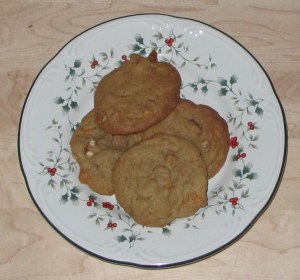
For my first attempt, I simply replaced the chocolate chips with butterscotch chips and replaced the nuts with pretzel pieces.   The result tasted good.  But, in my opinion, there was too much butterscotch flavor and not enough pretzel crunch.


So, I decided to try again.  This time I reduced the amount of chips by half and doubled the amount of pretzels. The changes were successful – these tasted great!

img_1968

Butterscotch Pretzel Cookies
2  1/4 cup flour
1 teaspoon baking soda
1 teaspoon salt
1 cup butter
3/4 cup granular sugar
3/4 cup brown sugar
2 eggs
1 teaspoon vanilla
1 cup butterscotch chips
2 cup pretzels, broken in to pieces

Preheat oven to 375 degrees F. Combine flour, baking soda and salt.  Beat butter, sugars and vanilla until creamy.  Add eggs, one at a time, beating well after each addition.  Gradually beat in flour mixture.  Stir in chips and pretzels. Drop by spoonfuls onto ungreased baking sheets. Bake for 10-12 minutes until golden brown.  Cool slightly, then transfer to wire rack to cool completely.

Winter Wonderland

Our first significant snowfall of the season has come.  We now have about 5 inches of snow, making my yard look like a winter wonderland.

While I am not very fond of driving in the snow and I really don’t like the cold weather that comes with it, I do like how pretty the snow looks.  The beauty of the snow comes just as I finish a table runner for my kitchen to use at Christmas time. I saw a lovely bargello runner a few years ago and decided that was what I wanted to make.

img_1998

Bargello Quilting

Bargello is a type of needlepoint embroidery that consists of upright flat stitches made to create motifs that depict motion.  The name originates from  a series of chairs in the Bargello palace in Florence, Italy, which have a “flame stitch” pattern.  Traditional designs are very colorful and use many hues of the same color for a shading effects that creates the sense of movement.

A bargello quilt is one that is made of strips of fabric sewn together to create the movement similar to that seen in bargello embroidery. The technique looks difficult, but is actually quite easy. If you can sew a straight seam, you can do this! Even though there appears to be  smany curves and shapes featured on the quilt, there is no curved piecing whatsoever.

All ranges of color are used, from light to dark. When choosing colors, there are many choices. A common option is a variety of shades in a single color family for a monochromatic quilt. Another common option is two complementary colors. That is why I decided to use this technique for my table runner – red and green are complementary colors and would work well for a bargello quilt.

Strips are cut at a specific width and sewn together lengthwise – I used 2″ strips of fabric that, when sewn, would finish to 1 1/2″ wide . The first and last strips are sewn together lengthwise forming a tube of strips with  the seam allowances facing out.

The tube is then cut vertically (opposite of the direction that they were sewn) to make many narrow loops. For my table runner, the strips were cut in the following widths:

1/2″   3/4″   3/4″   1″   1 1/2″   2″

These loops are then opened at the seam between different pieces of fabric and then sewn together.

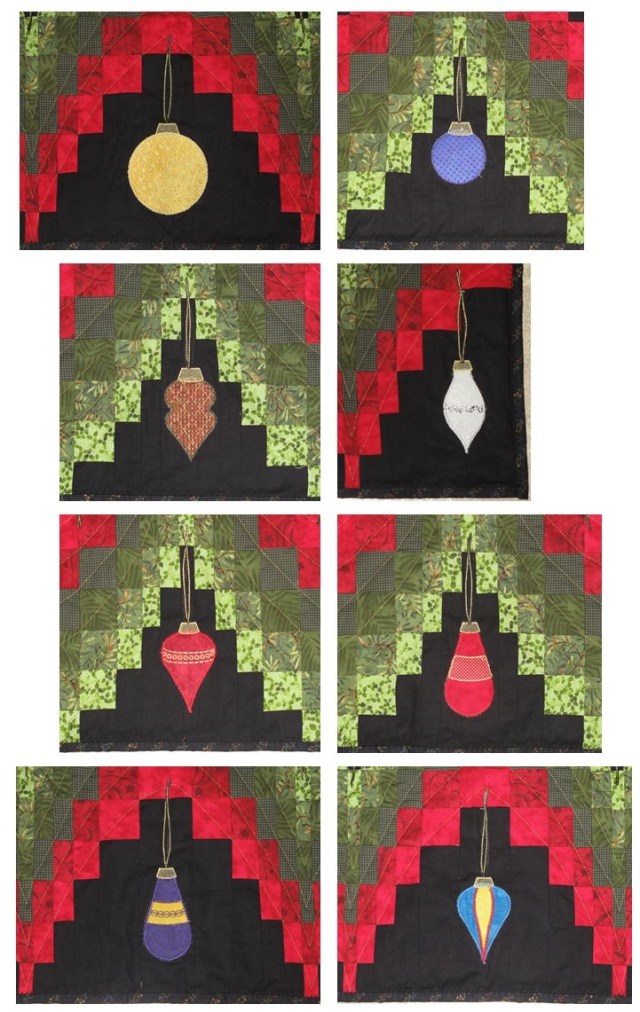
To add the ornaments, I used my Bernina cutwork tool to cut and embroider different colors of fabric and thread. Some were simple circles, some slightly more complicated shapes with embroidery to depict decoration on the ornaments.

embroidery

This was a fun project to make!

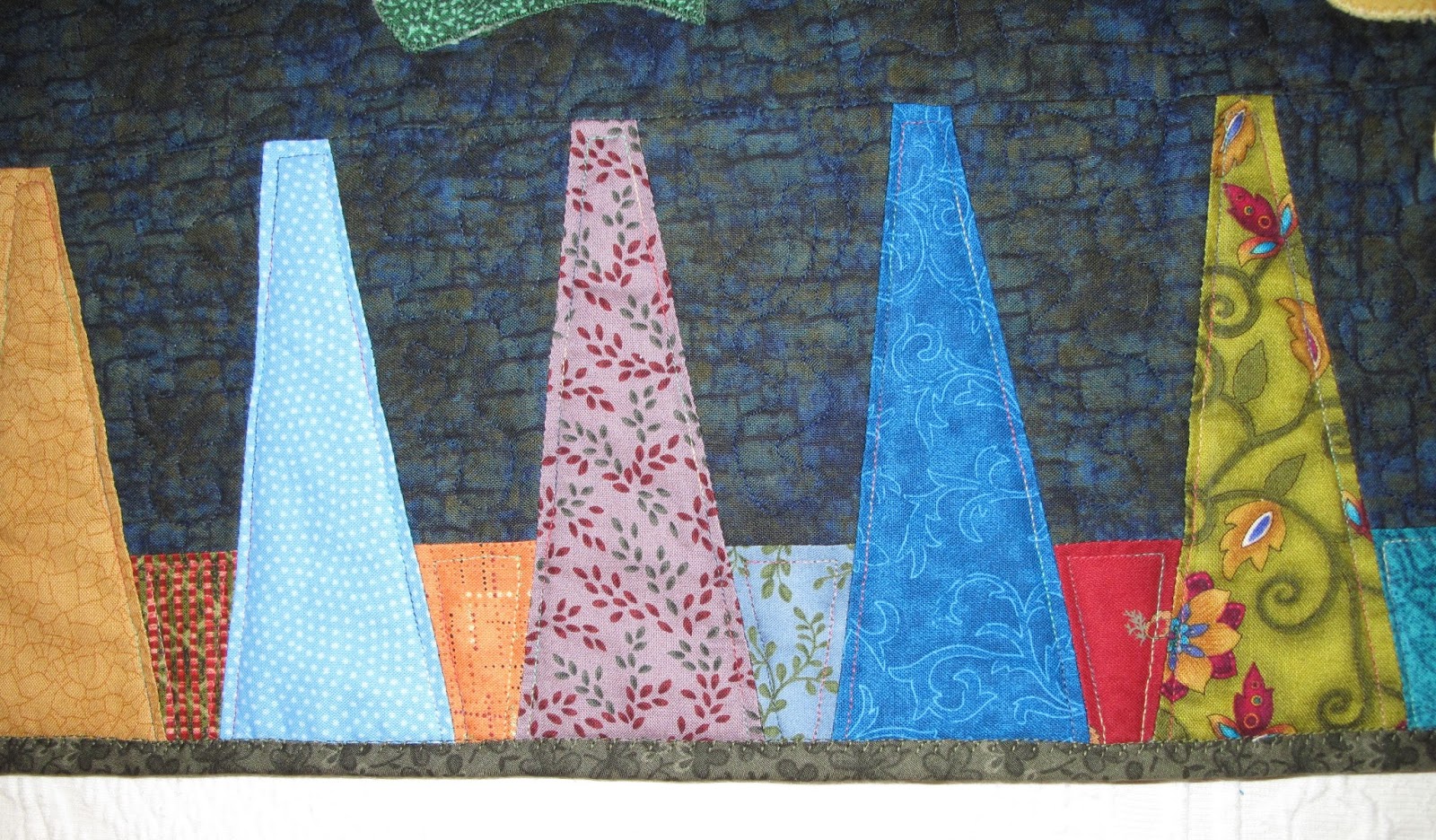
Window on My World – landscape quilt background panels.

When designing the backgrounds for the panels of my quilt, I wanted each panel to be different. In doing this, I was hoping that I could enhance the imagery of each season and each time of day.

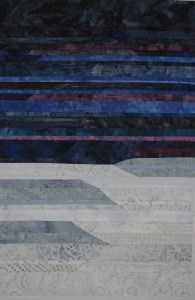
Winter / Midnight

img_1791


Starting with winter, I thought that strips of various shade of blue, navy and deep purple going across the sky might show the movement of a winter sky.

Then, I added snow in drifts for the ground.


img_1792


After sewing the snowdrifts, I decided that I did not like that the ground was different than the sky. So, off came the snow drifts.

New snow drifts were made of strips of white and grey fabric sewn to similar to the sky.

This I liked much better!

Spring / Sunrise

img_1793


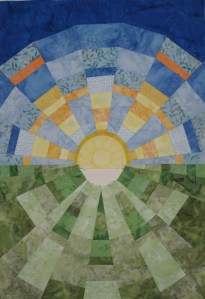
For spring, I wanted the piecing to highlight the sunrise. So, the blue, yellow and orange fabrics were sewn to depict the rays of the sun.

And, to keep each panel looking unified, I decided that the ground should also be sewn to look like the rising sun was casting rays of light on the ground.

Summer / Midday

img_1794


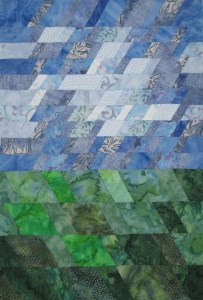
For summer, I wanted the piecing to highlight the tranquility of summer when a slight breeze is blowing.  To achieve this, I pieced the various shades of blue with a slight slope away from the center of the quilt.  The ground was then pieced to echo  or mirror  the slope of the sky.


Autumn / Sunset

img_1795


For autumn, I also wanted the piecing to highlight the sun, this time as the sun goes down below the horizon.

Yellow, orange and  red fabrics were used for the sun with various shades of blue and purple for the sky. These fabrics were sewn in strips but with shifts to show the sun rays.

The ground was sewn similar with various shades of darker green. Grey fabric was used to show the set of steps to one side of the yard.


Next post will include the applique designs for these panels.

A Day of Gratitude

thanksgiving

Thanksgiving Poem (modified)

Our table is set; great food you can bet.
It’s Thanksgiving Day, and we’re ready to eat;
All those near and dear us, are here today to cheer us.
This dinner is a winner, a wonderful treat.

It’s time to be thankful for all that God gives us;
Dear Lord, we are grateful; Dear God, hear our prayer.
It’s You we are praising; our voices we are raising;
Bless us and our family; keep us safe in your care.

By Joanna Fuchs

While every day I am thankful for the many blessings, today is the day set aside to express and celebrate our gratitude.  I am especially thankful for  many things – my faith, my wonderful husband, my four incredible boys, my extended family, my friends, my health… the list can go on and on.

My prayer today, as we celebrate this holiday, is that each of you will be blessed as well.


Window on My World – designing a landscape quilt.

blogger-image-677978051

Our home, once filled with the busy-ness of four boys, is considerably quieter with only one son still living at home.  And, this week he is on a field study trip with his school making our house even quieter.

Looking to the future, my husband and I have started thinking about moving in a few years.  When that happens, we will leave behind a house that I have spent considerable time and effort into making a lovely place to live.

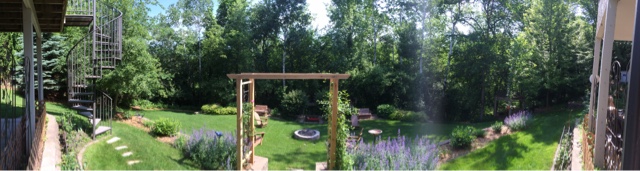
My backyard is especially enjoyable to me, with the trees and flowers and many places to sit and relax.  To help remember this space, I decided to make a landscape quilt that shows my yard.  I plan to call this quilt “Window on my World”.  The idea is that the quilt will depict a view of my yard looking out of a window. Since all seasons and all times of the day are enjoyable, I plan to incorporate various times into the quilt.

The window will have four panes in it.  Each pane will depict a different season in my backyard – Winter, Spring, Summer and Autumn.  And, each pane will depict different times of day – Midnight, Sunrise, Midday and Sunset.  So, starting from the farthest left pane and going right the landscape quilt will show the my yard:

  • Midnight in Winter
  • Sunrise in Spring
  • Midday in Summer
  • Sunset in Autumn

The first step in creating this quilt was to draw out my ideas on a few pieces of paper. I’m not very good at drawing, but these do show the idea fairly well.Composite.jpg

I now need to plan out the background.  To make the quilt more visually interesting, I am playing around with different piecing ideas for each pane. That will be the topic of my next posting.


It’s all Greek to Me

I have a very good friend who is originally from Greece.  A few years ago, we took a trip together and thoroughly enjoyed seeing the sites and tasting the foods.

Today is her birthday – Happy Birthday Venetia!!

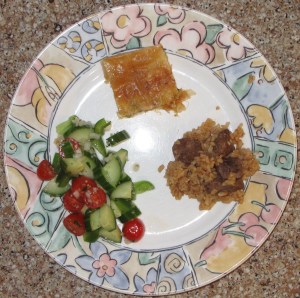
In honor of her birthday, I decided to make some Greek cuisine for dinner.

Our menu included (serves 3):img_1922

Kolokithopitta (Zucchini Pie)
1 zucchini, unpeeled and shredded
1 onion, finely chopped
1 clove garlic, chopped
1 T Olive Oil
1 tsp parsley chopped
1/2 tsp dill weed, chopped
1 egg, beaten
1/2 cup feta cheese, coarsely chopped
salt and pepper, to taste
4 sheets filo pastry, cut in fourths
2 T butter, melted
Preheat the oven to 350 degrees. Over low heat, saute the zucchini, onions and garlic in the oil until browned, stirring occasionally. In a bowl, combine the remaining ingredients except the filo and butter.  Butter a 5×7 pan. On the bottom, place 8 pieces of filo dough, each sheet brushed with butter.  Spoon the zucchini mixture over the filo.  Cover with 8 more pieces of filo, each brushed with butter.  Brush the top with butter.  Bake in the preheated oven for 45 minutes.  Cool slightly and cut into six pieces.

Salata (Greek Salad)
20 grape tomatoes, cut in half
1 cucumber, chopped
1 green pepper, seeded and chopped
1 onion, finely chopped
1 clove garlic, chopped
1 T Olive Oil
1 tsp vinegar
1/2 cup feta cheese, coarsely chopped
salt and pepper, to taste
Combine all vegetables.  Serve with feta sprinkled on top. Most Greek salads have olives on top.  But, since I don’t like olives, I don’t have any in my refrigerator.

Psimeno Arni Pilafi (Baked Lamb Pilaf)
8 ounces lamb stew meat
1 T tomato paste
1 tsp oregano
1 clove garlic, chopped
1 T Olive Oil
1 cup brown rice
1 cup vegetable broth
salt and pepper, to taste
Preheat the oven to 350 degrees. Combine tomato paste, oregano, garlic and oil.  Coat the chicken pieces with the mixture and place in a baking dish.  Bake in preheated oven for 30 minutes.  Add rice and broth.  Cover and cook for an additional 30 minutes.

Cranberry Orange Relish, Wild Rice Bread and Canning

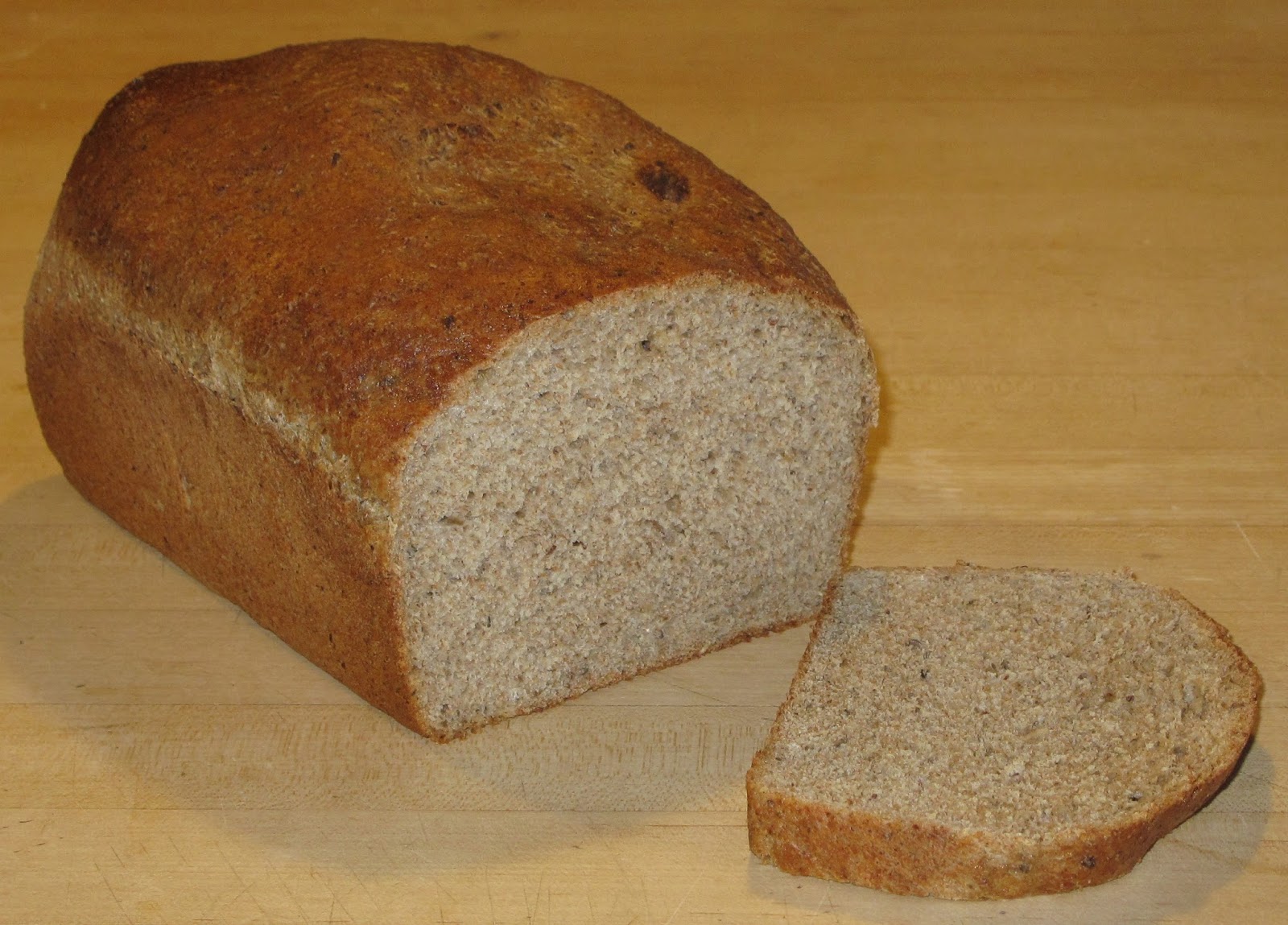
I recently ate one of the best tasting sandwiches I have ever had. This sandwich was roast turkey on wild rice bread with a cranberry orange relish, lettuce, arugula, white cheddar cheese and thin sliced apple.

I liked it so much, that I decided to try to try to make my own bread and relish. The results were actually better than what I remembered from my purchased sandwich.

Cranberry Orange Relish
16 ounces frozen cranberries
2 navel oranges, peeled and chopped
2 cups water
2 cups sugar

Combine the cranberries, oranges and water in a large saucepan.  Boil until the skins of the cranberries burst.  Puree in a food processor. Pour mixture back into the saucepan and stir in sugar. Heat to boiling and continue to cook until the gel stage is achieved. Ladle into jars and process in a boiling water bath for 15 minutes.

Note – it took about 90 minutes to reach the gel stage.

Wild Rice Bread
1 1/4 cup water
1/4 cup ground uncooked wild rice
2 cups whole wheat flour
1 1/2 cup bread flour
2 T honey
2 T canola oil
2 T flax seeds, ground
1/2 T yeast
1 T salt

Layer the ingredients in the bread maker pan in the order given.  If doing overnight, make sure that the honey, yeast and salt are on top of the flour so that they do not come in contact with the water until the mixing process begins.

Mix and knead according to your bread maker setting for whole grain breads.
Do not bake in the bread maker.
After the dough has risen once, remove the dough, form into a ball and place in a greased traditional bread pan.  Allow to rise until at least one inch higher than the edge of the pan.

Bake 375 degrees for 35-40 minutes.

Note – not having a wheat grinder, I tried several different ways to grind the rice. I found that the Nutra Ninja worked the best.  In the future, I think I will purchase wild rice flour.  While it is expensive, the recipe does not use very much.  And, I can try it in other recipes to see if I like the added texture and taste.

Canning 2016
While making the cranberry relish, I also made some Citrus Marmalade.

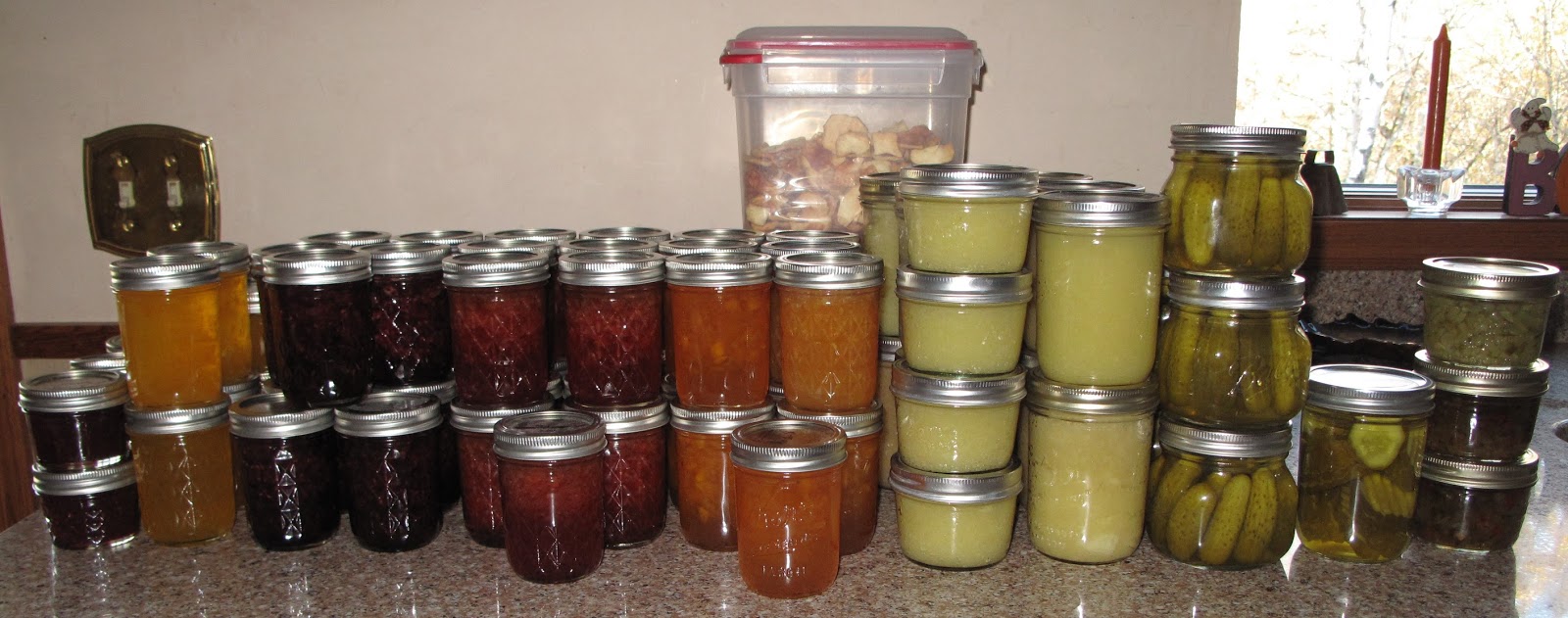
Thus my canning for the 2016 summer is complete.
Here is what my pantry
holds:
Strawberry Jelly – 13 jars
Triple Berry Jelly – 13 jars
Peach Jelly – 13 jars
Citrus Marmalade – 7 jars
Cranberry Orange Relish – 7 jars
Applesauce – 15 jars
Dill Pickles – 5 jars
Hamburger Dills – 2 jars
Sweet Relish – 2 jars
Dill Relish – 2 jars
Dehydrated Apples – 15 cups


Arashi Shibori Experiment

Arashi Shibori, pole wrapping, creates an interesting dye pattern in the fabric. Because I liked how my initial samples turned out (see April 13, 2016 and August 12, 2016 postings), I decided to do a small experiment.  To assess the effect of the amount of compaction of the fabric has on the dye pattern, the following experiments were completed.
Experiment #1:
1. PVC pipes with caps (to reduce the amount of dye needed)
2. Three pieces of fabric  cut 8″ x 45″, stitched together using a long stitch length to form a tube of fabric, and scrunched onto the pipe
3. Scrunch one piece of fabric:
– loosely, about 20″ in length
– moderatly, about 15″ in length
– tighly, about 10″ in length

8 inch wrap

Experiment #2:

1. PVC pipes with caps (to reduce the amount of dye needed)
2. Three pieces of fabric  cut 9″ x 45″, stitched together using a long stitch length to form a tube of fabric, and scrunched onto the pipe
3. Scrunch one piece of fabric:
– loosely, about 20″ in length
– moderatly, about 15″ in length
– tighly, about 10″ in length
9 inch wrap


Experiment #3:

1. PVC pipes with caps (to reduce the amount of dye needed)
2. Three pieces of fabric  cut 10″ x 45″, stitched together using a long stitch length to form a tube of fabric, and scrunched onto the pipe
3. Scrunch one piece of fabric:
– loosely, about 20″ in length
– moderatly, about 15″ in length
– tighly, about 10″ in length

10 inch wrap

I now have samples that I can refer to when planning to dye fabric using this technique. Can’t wait to try some more fabric dyeing.

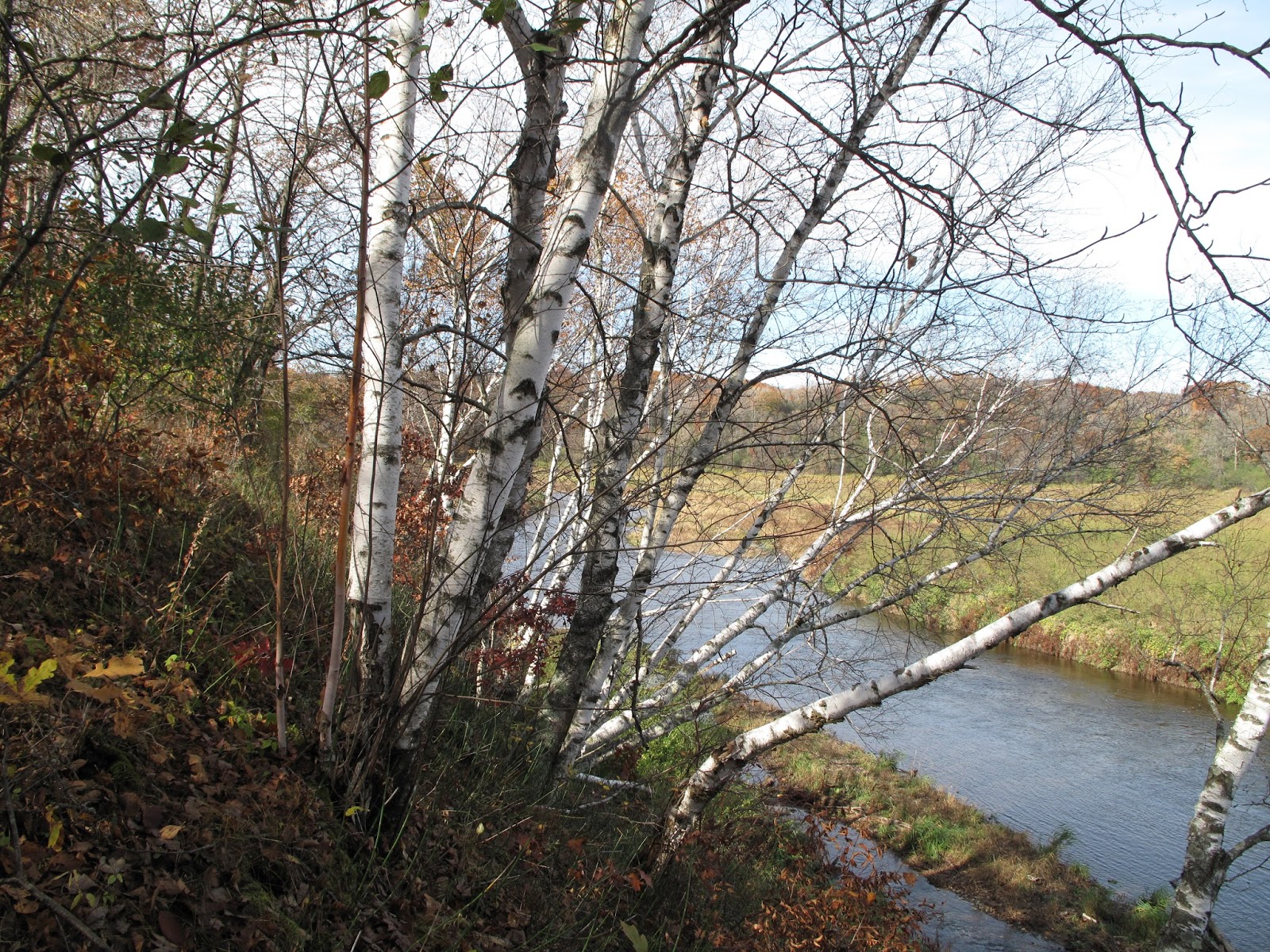
Fall has arrived in Minnesota

After a couple rainy weeks, the weather has dried out and we are having a lovely weekend. Today, I spent a few hours outside adding bulbs to my flower gardens. I even put some in planter inserts that fit inside the copper planters at my front door.  It will be nice to see what sprouts in the spring.

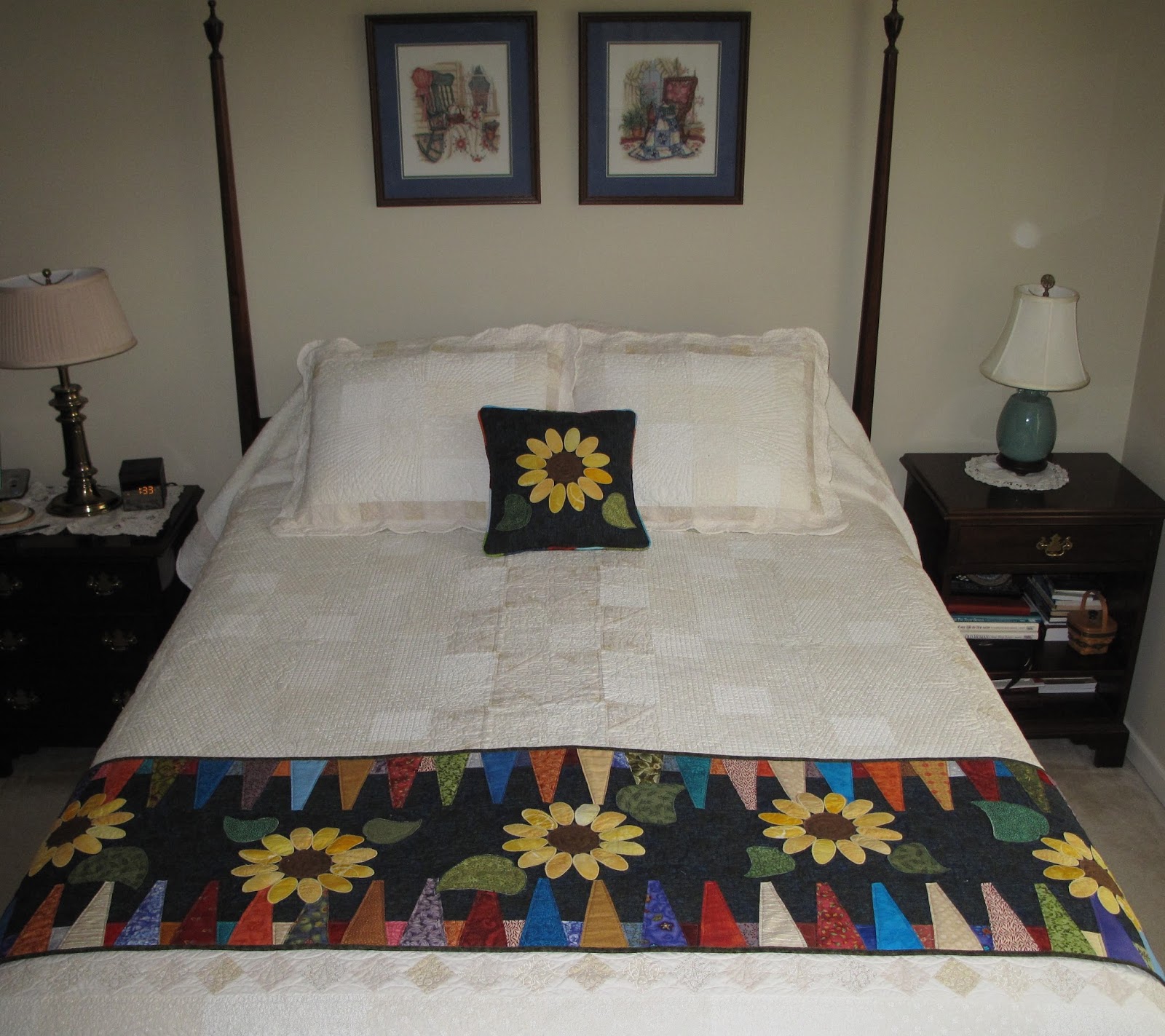
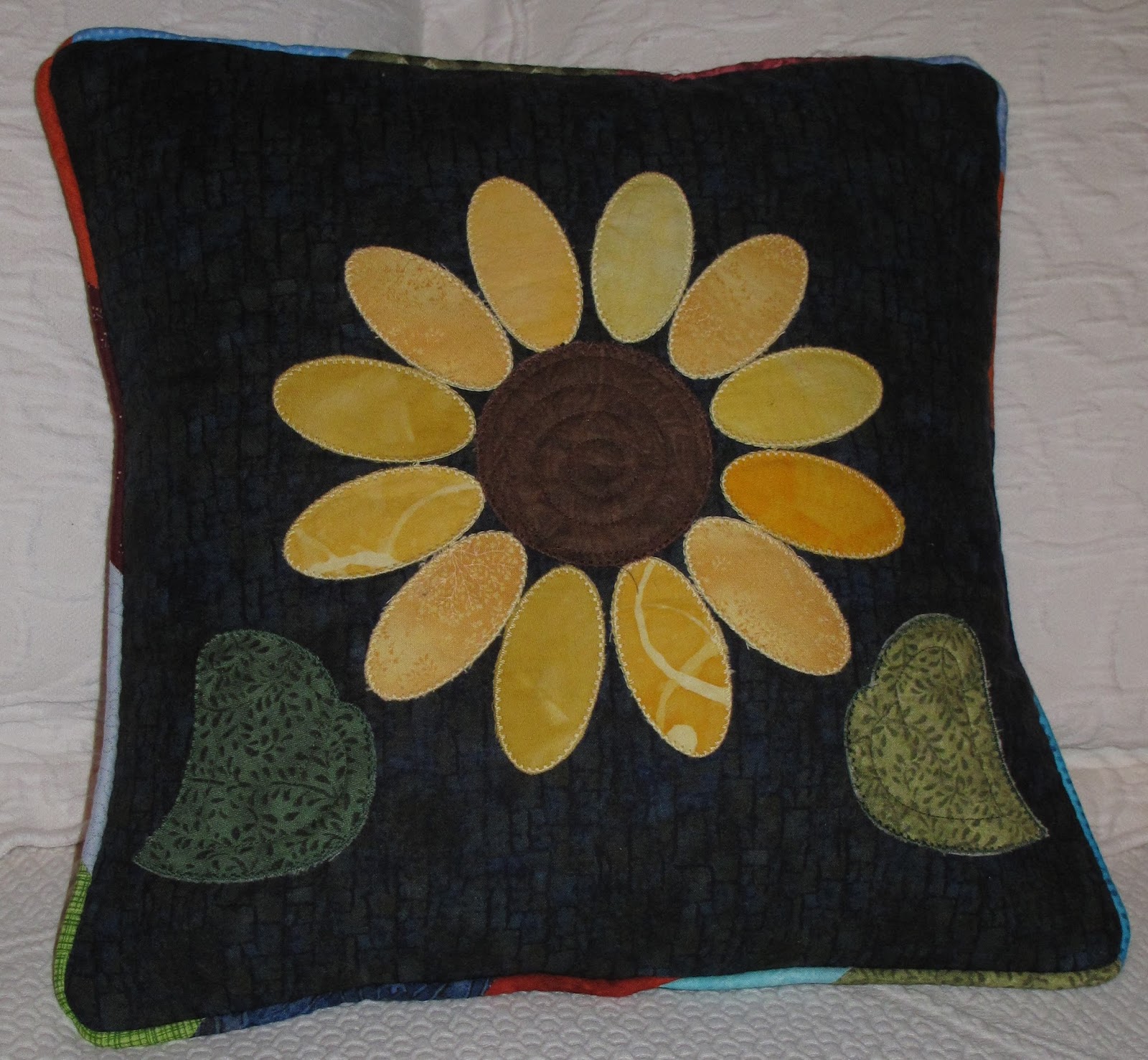
In anticipation of the arrival of cooler weather, I have been working on a new bed runner. Since I really love flowers, sunflowers  runner would be nice.

Using my Bernina Cutwork Tool, I cut seventy-two oval from hand-dyed fabrics, 12 leaves and six center from green and brown scraps of fabric.

Since the sunflowers are mainly yellow, I decided to add color in a scrappy border for the runner.

And, a pillow with a scrap piping to add an accent!