
Overlapping Triangles Quilt and Plate

IMG_2504
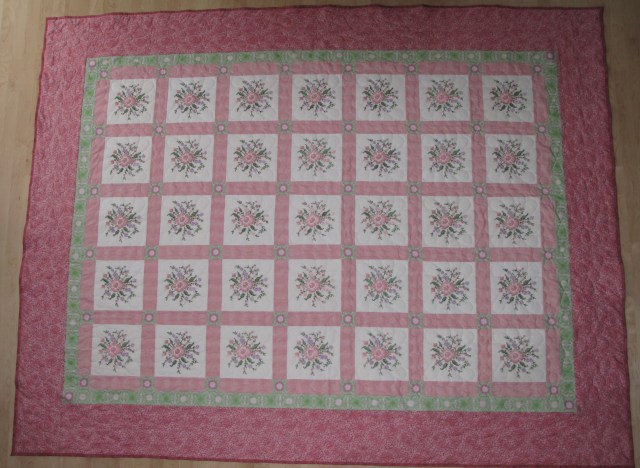
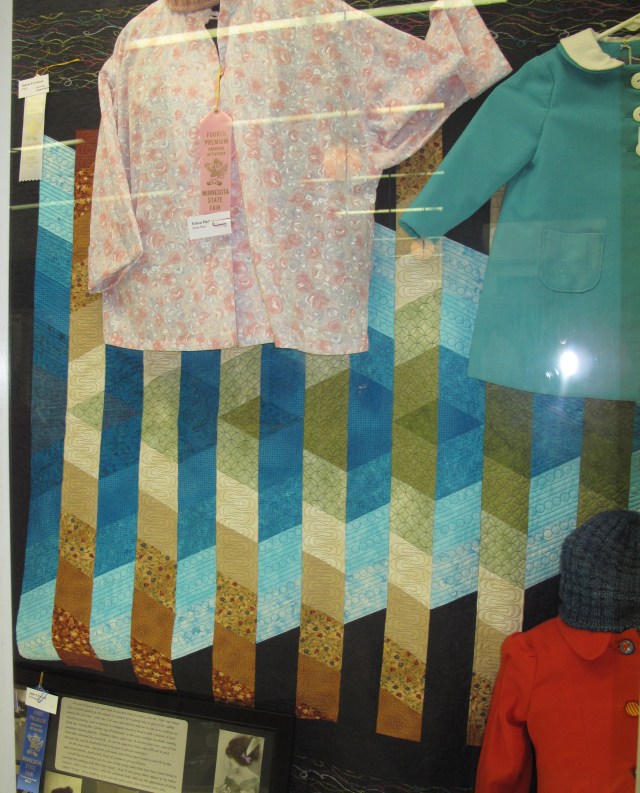
“Overlapping Triangles”  twin sized quilt.

Last year, one of the awards I received from the Minnesota State Fair included a gift certificate to  Bear Patch Quilting in White Bear Lake.  So, last fall I drove up to the store to see what to spend my certificate on.  I had some ideas of fabric I wanted, however, when going through the shop I was unable to find anything matching my ideas. Not wanting to drive up there again on another day, I looked around and found some fabric that I liked.  Without any plans for what I was going to make, I purchased two yards of the black fabric and took it home.

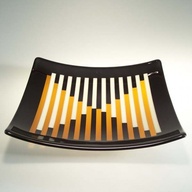
Overlapping Triangles Plate
My inspiration.

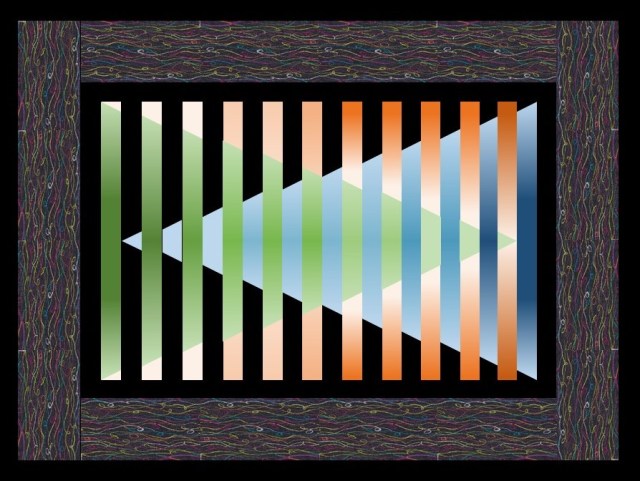
Several months later, when looking at some fused glass ideas, I came across a plate that I really liked. And, upon thinking about it, I realized it would make a nice quilt pattern as well. So, I went to my computer and came up with an idea for a quilt to make using the fabric.  Using the colors of the black swirled fabric, I designed the quilt to have graduated colorings in the strips.  When designing, I didn’t like the blunt ends of the triangles and decided to angle them.  I also decided to make the triangles overlap.

Overlapping Triangles 2
My design.

When I went through the fabrics in my stash, I was happy to find that I had enough of each of the colors I selected that I only needed to purchase the black fabric needed.

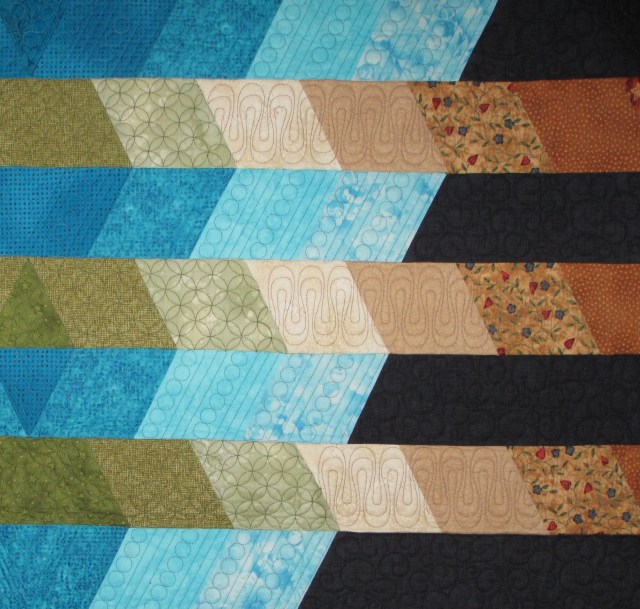
IMG_2474
Close-up of quilting.

This summer, I finally pulled out these fabrics and started working on my idea. Finishing it in time for the state fair, I decided to enter it and received a third place ribbon.

4
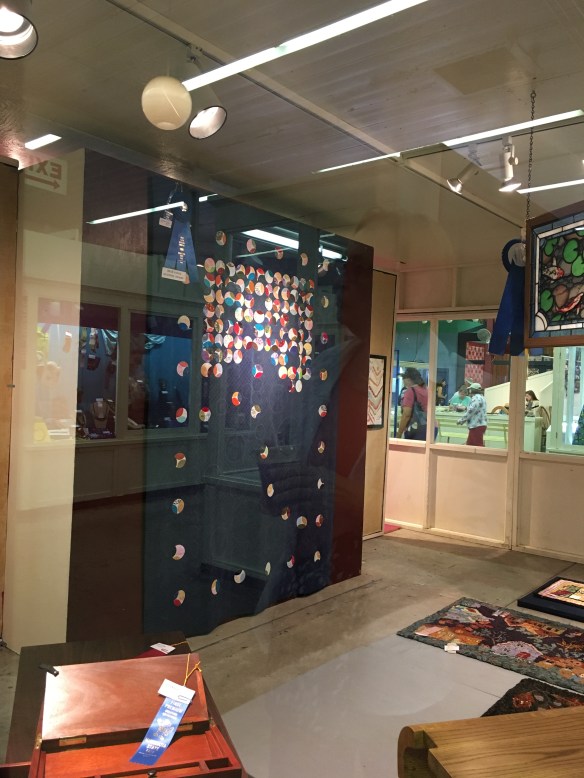
MN State Fair Display.

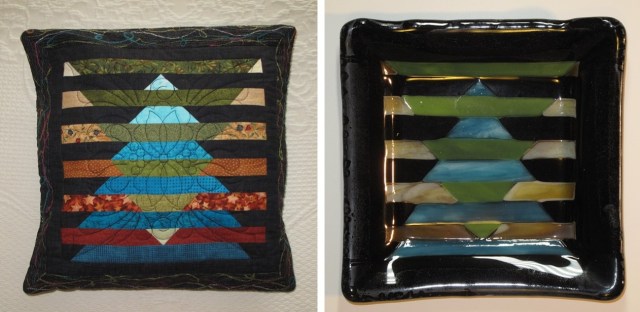
While the quilt was on display at the fair, I made some things to go with the quilt.

Combo
Matching Throw Pillow and Fused Glass Plate.


Minnesota State Fair

1It’s Fair time in Minnesota.  Most people who post fair pictures on social media that show the many foods eaten at the fair.  Today, when I went to the fair, I actually didn’t eat anything, although the food did smell really good! But, I did spend a couple hours looking at the projects in the Creative Activities Building.  Lots of wonderful craftsmanship on display.
Here are my quilts:

2
“Bounce” – hung upside down, even though I had put a note on the quilt to designate the bottom of the quilt.  Placed first in the scrap quilt category.


3
“Window on My World” – kinda hidden in the back of the display case.  No ribbon for this quilt.
4
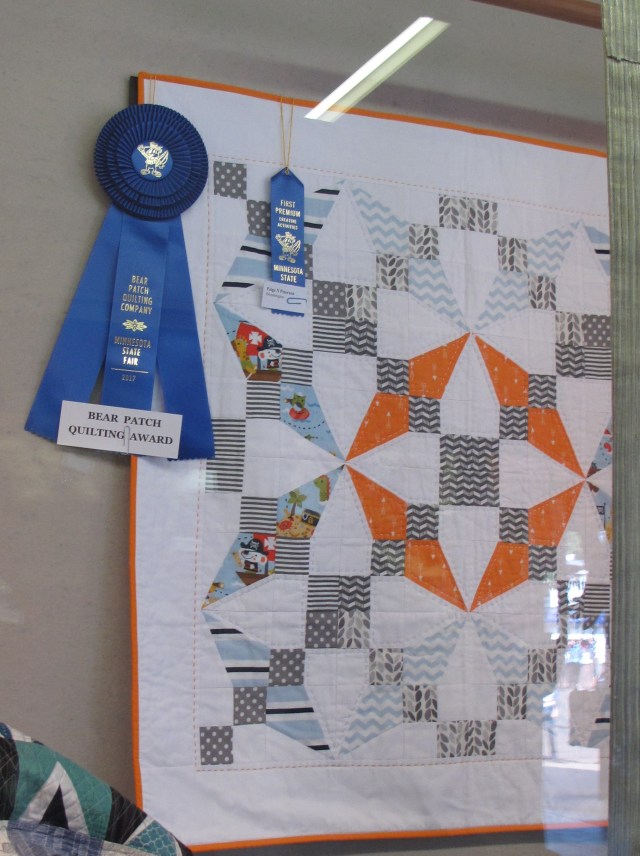
“Overlapping Triangles”  – placed third in the pieced bed quilt category.  I will post more pictures of this one once I get it back from the fair.

I took lots of pictures of other quilts as well:

5
Sweepstakes Winner – Zeeda Magnuson
6
Best Use of Color – Patricia Henseler
7
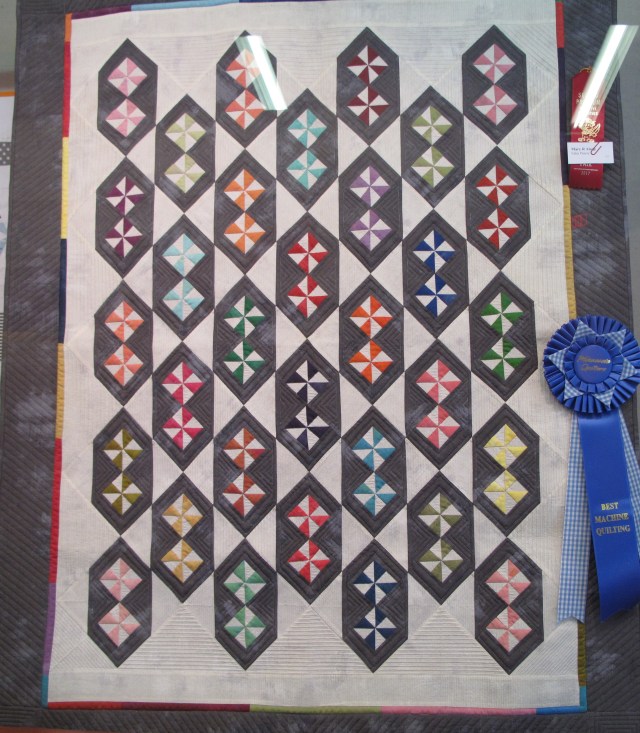
Best Machine Quilting – Mary Alsop
8
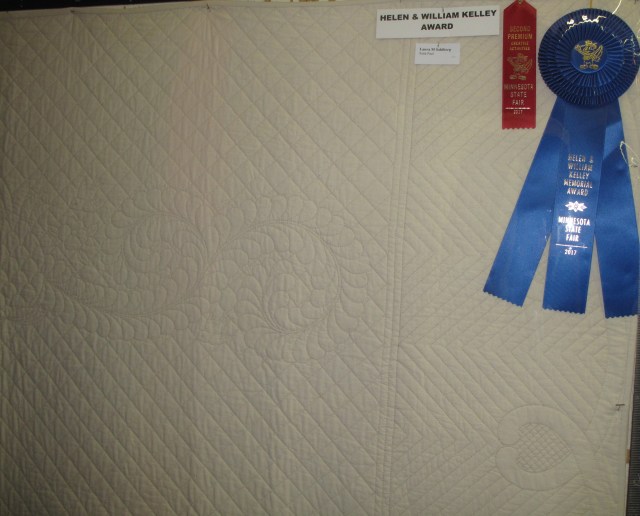
Best Hand Quilting – Laura Sahlberg
9
Best Child/Crib Quilt – Paige Peterson
10
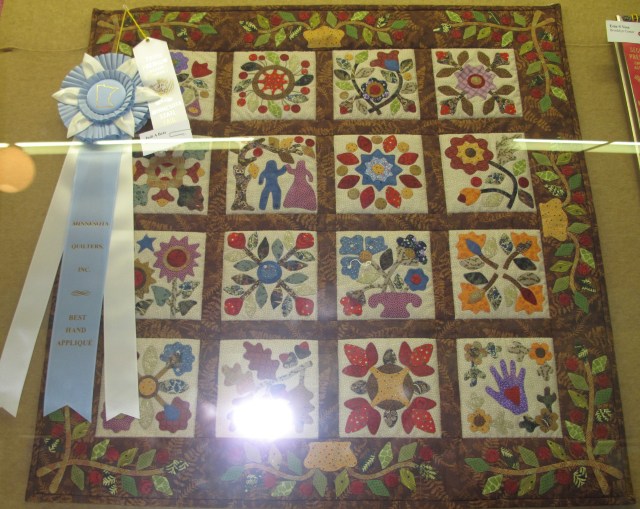
Best Hand Applique – Judi Betz

And other crafts that caught my eye:

IMG_5094.JPG
Dog House – Greg Aamodt – he’s actually the dad of my husband’s business partner
IMG_2444
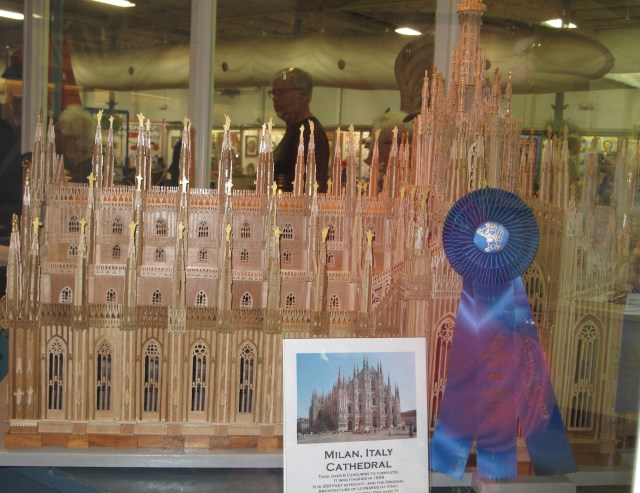
Milano Cathedral – Not sure who the craftsperson was, but this was awesome.

Split Blocks – Fun and easy quilt piecing

Sometimes ads come up on my Facebook news feed that catchIMG_1524-2-352x228 my attention.   That happened recently with some fabrics. The offer was for pack of  5″ charm square, 102 pieces in all.  The colors looked so nice and the price was excellent.  So, I purchased a set.  I had no idea what I was going to make with them, and I certainly didn’t need any more fabric.  But, they were just too pretty to pass up.
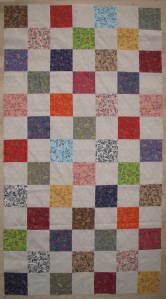
Once they arrived, I started thinking about the many quilt patterns that I want to try. Since the pack was small 5″ squares, I knew that I couldn’t do anything really fancy with them.  So, I decided to try some “split block” ideas.

Split block techniques involve sewing squares of fabric together, either jelly rolls, 5″ charms or other sizes, and then cutting them along different lines and/or angles to make new blocks.

IMG_2139

The first idea I tried was an Interrupted Four Patch.  This pattern involves sewing the charm squares alternately with a background fabric. IMG_2067

The sewn piece is then cut into strips 1/3 and 2/3 of the  size of the blocks. A contrasting fabric strip is then sewn between each horizontally cut strip. This is repeated with verticalIMG_2069 strips, borders added and the quilting completed.

IMG_2140

The nexIMG_2062t idea I tried was the “Twister”. This pattern also involved sewing the charm squares together alternating with a background fabric.


Then the sewn piece is cut at an angle with a template, twisted to make pinwheels, and sewn together.

There are templates in a variety of sizes available for this quilt pattern. But, I really don’t need more templates, so I just drew temporary lines on my 4″ square template and used that.

For this quilt, I did not have enough fabric to make as many pinwheels as I needed.  So, I decided to add pinwheels with quilting.  Kinda a fun way to continue the pattern to a larger size.

Some interesting blocks to try in the future:

  • Disappearing four patch
  • Disappearing nine path
  • Fence Rail

Spring Has Sprung!

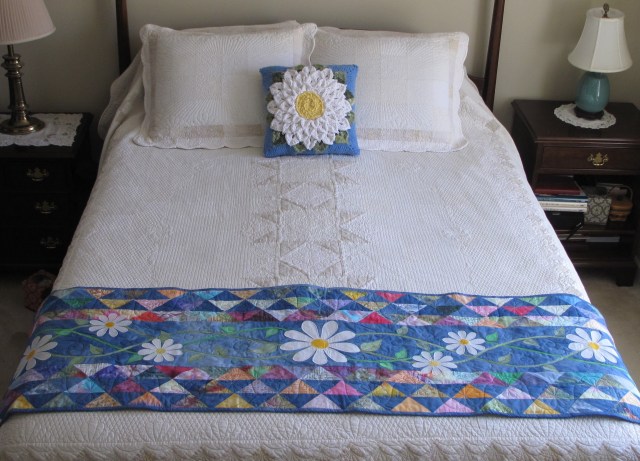
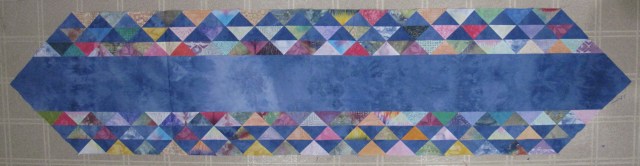
It’s April, the birds are singing outside my window, the bulbs are coming up in my gardens and the grass is starting to get green.  So, it’s time to change the decor in my bedroom – a new Daisy Bed runner really added some springtime color.


IMG_2115

To make this bedrunner, I used the leftover blue fabric from the backing of my butterfly quilt as the main background.  To supplement the blue, I took out some of my custom dyed fabric samples, generally ones that were trials on different dyeing techniques. For added color, I decided to try out some fabric paint crayons.

A few years ago, I took a class on Shiva Paintsticks and Rubbing Plates.  I enjoyed the class and purchased some supplies.  However, time being in short supply, I really hadn’t used them since completing the class.

This project, I thought would be a good use of the paintsticks to embellish the fabrics that I had in my collection. After a day of painting, I set the fabrics aside for a week to allow the oils in the dye crayons to dry.  The dye pigment was then heat set by ironing the fabric between pieces of brown paper (absorbs the excess oils very nicely).  The resulting fabrics were really interesting.

Triangles were cut out of the fabrics and the border was then made by alternating triangles of blue and color.

IMG_1754

To enhance the bedrunner, daisies and leaves were appliqued onto the center panel. The runner was quilted and the binding added.


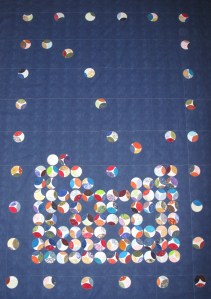
Bounce – a playful quilt depicting the view of a child’s ballpit

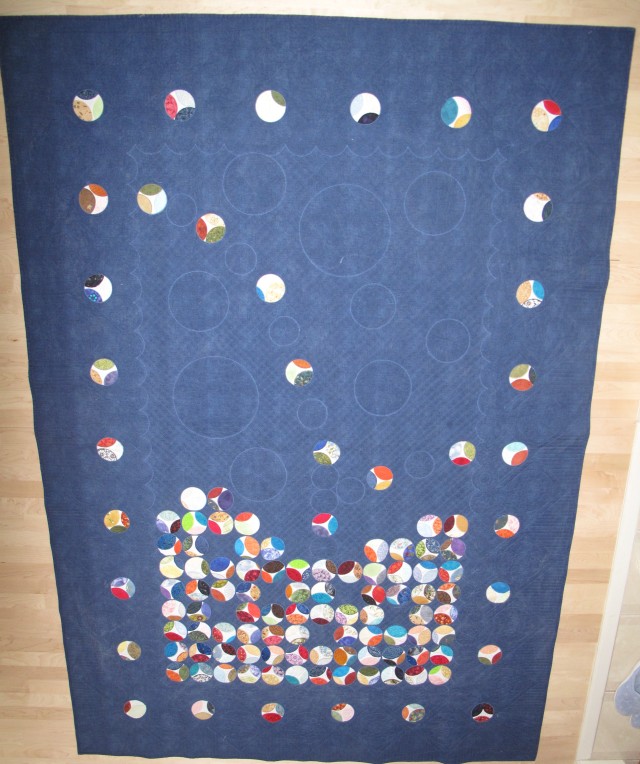
As promised, I took some pictures of my quilt.  This is a twin sized quilt.  The scalloped edge along the stitched circles marks the edge of the mattress.  So, when on a bed, the view of the ball pit and the bounce line will be very visible.  The border spaced balls will fall on the overhanging quilt border.

IMG_2056
Quilt Front

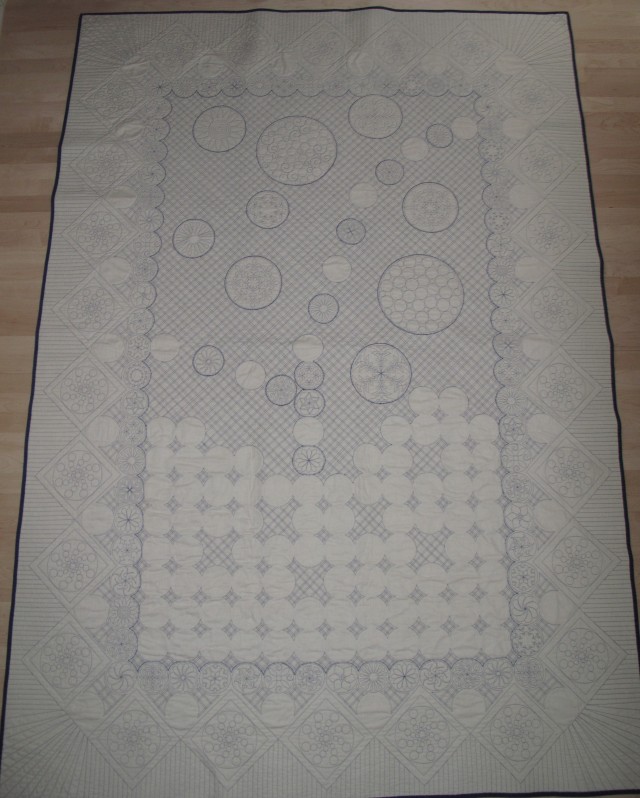
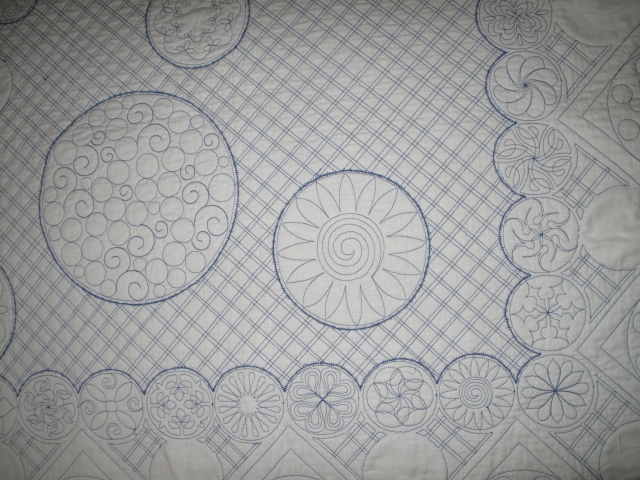
Because the background is dark, it is hard to get a good photo that shows the stitching. However, I used a light tan for the backing. Flip over the quilt, and the stitching is very visible.  After finishing the long-arm quilting, I felt that the stitched balls were getting lost in the background and hard to see.  So I added a decorative stitch edging to these stitched circles. I think it really helps make the circles stand out more both on the front, but especially on the back, of the quilt.

IMG_2086
Quilt Back
IMG_2092
Close-up of Stitching

This quilt was a lot of fun to make.  Certainly the most stitch edged applique that I have ever done.  I have so many other ideas for quilts to make.  Time to get sewing again!


National Quilting Day

Today is National Quilting Day.  And, how did I spend my day – quilting, of course!

I was actually able to finish a quilt that I started a few weeks ago. The lighting at the time I finished binding the quilt was not adequate to take good photos.  So, I will post the finished photos tomorrow after I am able to take some nicer photos.

However, I did take photos along the way as I worked on this quilt.

IMG_2029
Applique completed
Upholstery
Upholstery Fabric

I have named the quilt “Bounce”. The idea was inspired by the vinyl upholstery fabric on the chairs in the staff lounge at Children’s Hospital Surgery Center.

A little over a year ago, we were also considering this fabric for our office remodel.  When I brought a sample of the vinyl to show our staff, one person commented that it looked like a quilt pattern.

Idea
Design


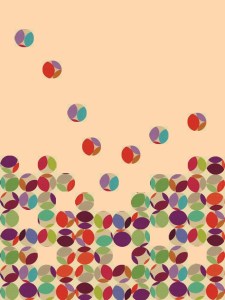
Ultimately we selected a different fabric. But, the idea of making a quilt stuck in my mind. A design was created that took the circles of the fabric and replicated them in an applique pattern that looked like balls bouncing in a ball pit.

This winter, I was able to start working on the quilt. This has been a really fun quilt to make!

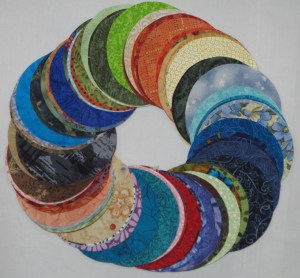
Using scraps from previous quilts, I first cut out 124 circles measuring 3.25″.

IMG_1929

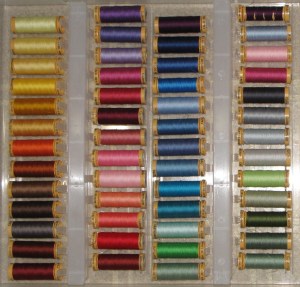
These circles were then appliqued onto white cotton fabric using my collection of Gutermann thread (50wt).

IMG_1931

From the appliqued fabric, I then drew and cut circles that overlapped the appliqued circles so that the resulting pieces looked like balls. This double applique approach really made this quilt easier to applique than it appears to be.  Basically I was only having to stitch circles each time, rather than partial circles.

IMG_1930

For the background of the quilt, I kept debating between tan and sky blue.  Then, one day, while looking for backing for another quilt, I found some fabric that looked like denim and thought that would be a nice background.

Final pictures tomorrow….


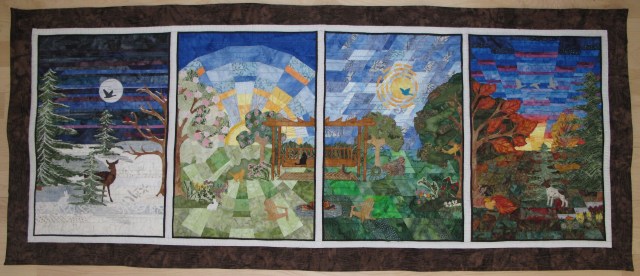
Window on My World – quilting and hand embroidery. I’m done!

img_2039

After hours of quilting and hand embroidery, I have finished my lanscape quilt. I am very pleased with the result. Hopefully when I look at it, I won’t find something that I want to change.

Each season has lots to look at – animals, plants, etc.  It really does look like my backyard.

img_2041
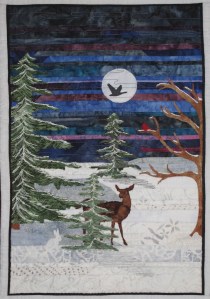
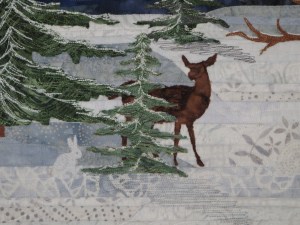
Winter / Midnight
img_2042
Spring / Sunrise


img_2043
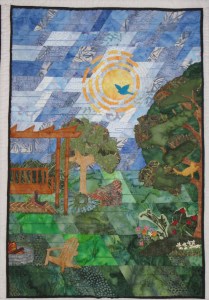
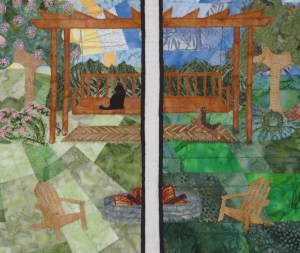
Summer / Midday


img_2044
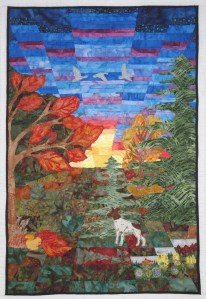
Autumn / Sunset


Some of the details:

img_2045
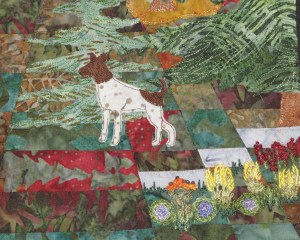
Our first dog, a German Shorthair Pointer named Striker, and some hand embroidered flowers.
img_2046
One of our first cats, Comet, who liked to climb trees, and some more flowers.
img_2047
Our yorkie, Duke, barking an our cat, Onyx.  Onyx is always trying to get up and away from him.
img_2048
Our oldest cat, Squigglez, who will be thirteen years old this summer, does enjoy wondering in the yard in the summertime.
img_2049
Having a heavily wooded yard and lots of plants, we have lots of wildlife that visit.


Winter Wonderland

Our first significant snowfall of the season has come.  We now have about 5 inches of snow, making my yard look like a winter wonderland.

While I am not very fond of driving in the snow and I really don’t like the cold weather that comes with it, I do like how pretty the snow looks.  The beauty of the snow comes just as I finish a table runner for my kitchen to use at Christmas time. I saw a lovely bargello runner a few years ago and decided that was what I wanted to make.

img_1998

Bargello Quilting

Bargello is a type of needlepoint embroidery that consists of upright flat stitches made to create motifs that depict motion.  The name originates from  a series of chairs in the Bargello palace in Florence, Italy, which have a “flame stitch” pattern.  Traditional designs are very colorful and use many hues of the same color for a shading effects that creates the sense of movement.

A bargello quilt is one that is made of strips of fabric sewn together to create the movement similar to that seen in bargello embroidery. The technique looks difficult, but is actually quite easy. If you can sew a straight seam, you can do this! Even though there appears to be  smany curves and shapes featured on the quilt, there is no curved piecing whatsoever.

All ranges of color are used, from light to dark. When choosing colors, there are many choices. A common option is a variety of shades in a single color family for a monochromatic quilt. Another common option is two complementary colors. That is why I decided to use this technique for my table runner – red and green are complementary colors and would work well for a bargello quilt.

Strips are cut at a specific width and sewn together lengthwise – I used 2″ strips of fabric that, when sewn, would finish to 1 1/2″ wide . The first and last strips are sewn together lengthwise forming a tube of strips with  the seam allowances facing out.

The tube is then cut vertically (opposite of the direction that they were sewn) to make many narrow loops. For my table runner, the strips were cut in the following widths:

1/2″   3/4″   3/4″   1″   1 1/2″   2″

These loops are then opened at the seam between different pieces of fabric and then sewn together.

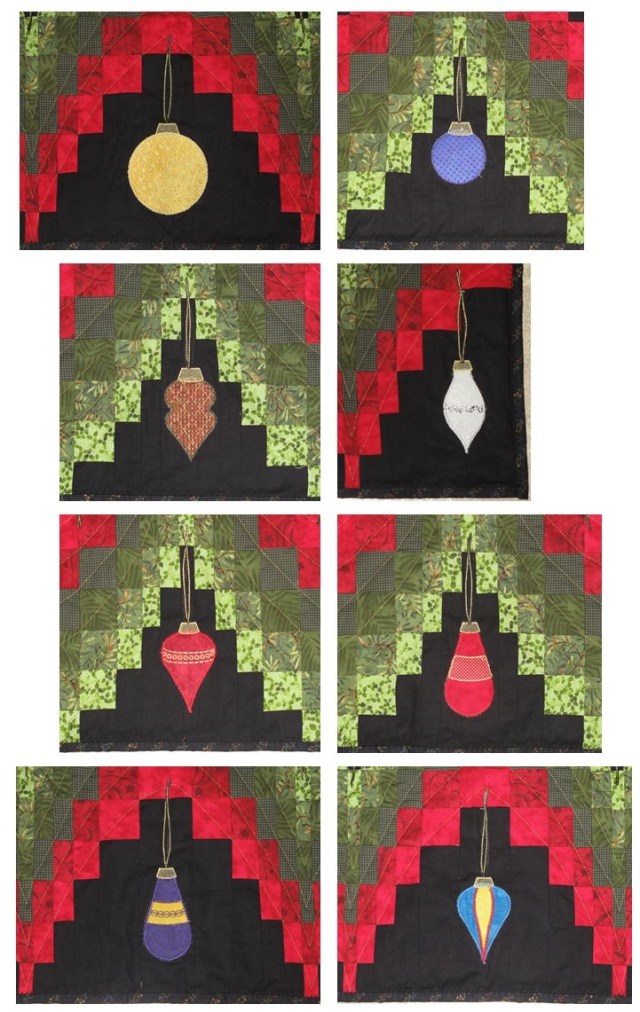
To add the ornaments, I used my Bernina cutwork tool to cut and embroider different colors of fabric and thread. Some were simple circles, some slightly more complicated shapes with embroidery to depict decoration on the ornaments.

embroidery

This was a fun project to make!

Window on My World – landscape quilt background panels.

When designing the backgrounds for the panels of my quilt, I wanted each panel to be different. In doing this, I was hoping that I could enhance the imagery of each season and each time of day.

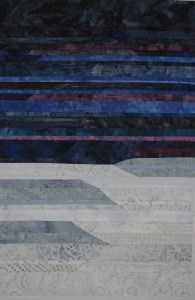
Winter / Midnight

img_1791


Starting with winter, I thought that strips of various shade of blue, navy and deep purple going across the sky might show the movement of a winter sky.

Then, I added snow in drifts for the ground.


img_1792


After sewing the snowdrifts, I decided that I did not like that the ground was different than the sky. So, off came the snow drifts.

New snow drifts were made of strips of white and grey fabric sewn to similar to the sky.

This I liked much better!

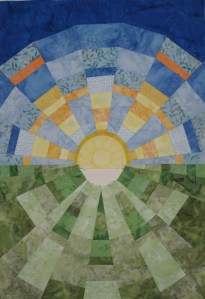
Spring / Sunrise

img_1793


For spring, I wanted the piecing to highlight the sunrise. So, the blue, yellow and orange fabrics were sewn to depict the rays of the sun.

And, to keep each panel looking unified, I decided that the ground should also be sewn to look like the rising sun was casting rays of light on the ground.

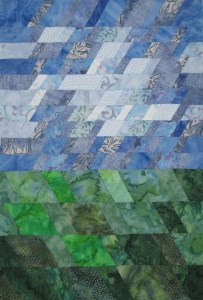
Summer / Midday

img_1794


For summer, I wanted the piecing to highlight the tranquility of summer when a slight breeze is blowing.  To achieve this, I pieced the various shades of blue with a slight slope away from the center of the quilt.  The ground was then pieced to echo  or mirror  the slope of the sky.


Autumn / Sunset

img_1795


For autumn, I also wanted the piecing to highlight the sun, this time as the sun goes down below the horizon.

Yellow, orange and  red fabrics were used for the sun with various shades of blue and purple for the sky. These fabrics were sewn in strips but with shifts to show the sun rays.

The ground was sewn similar with various shades of darker green. Grey fabric was used to show the set of steps to one side of the yard.


Next post will include the applique designs for these panels.

Window on My World – designing a landscape quilt.

blogger-image-677978051

Our home, once filled with the busy-ness of four boys, is considerably quieter with only one son still living at home.  And, this week he is on a field study trip with his school making our house even quieter.

Looking to the future, my husband and I have started thinking about moving in a few years.  When that happens, we will leave behind a house that I have spent considerable time and effort into making a lovely place to live.

My backyard is especially enjoyable to me, with the trees and flowers and many places to sit and relax.  To help remember this space, I decided to make a landscape quilt that shows my yard.  I plan to call this quilt “Window on my World”.  The idea is that the quilt will depict a view of my yard looking out of a window. Since all seasons and all times of the day are enjoyable, I plan to incorporate various times into the quilt.

The window will have four panes in it.  Each pane will depict a different season in my backyard – Winter, Spring, Summer and Autumn.  And, each pane will depict different times of day – Midnight, Sunrise, Midday and Sunset.  So, starting from the farthest left pane and going right the landscape quilt will show the my yard:

  • Midnight in Winter
  • Sunrise in Spring
  • Midday in Summer
  • Sunset in Autumn

The first step in creating this quilt was to draw out my ideas on a few pieces of paper. I’m not very good at drawing, but these do show the idea fairly well.Composite.jpg

I now need to plan out the background.  To make the quilt more visually interesting, I am playing around with different piecing ideas for each pane. That will be the topic of my next posting.