Dyed Fabric Strip Quilt
Creating a Legacy though the things I love – Fiber Arts, Flora, Food, Faith and Fun

Like most quilter, I have lots of fabric in my craft room. But, unlike other quilters, I try to keep the amount as low as possible. I no longer purchase fabric “just because see it and like it”. I have to have a specific project that I plan to use it in before I will purchase any fabric. Over the past few years, I have also received fabric from my sister, my mother and some of my friends. So, I really do not need to add to my stash.
When I am designing a quilt, I try to plan around fabrics that I already have. If I do need to purchase fabric, I calculate the amount of fabric yardage I need to be a careful not to purchase more than necessary. Sometimes this has been to my frustration, especially if I decide to change the design and find that I am needing more fabric to make the changes. But, usually this works well and keeps me from having too many scraps left over. I have even created an Excel spreadsheet that helps me calculate the yardage quickly. If you are interested, email me and I can send you the file.
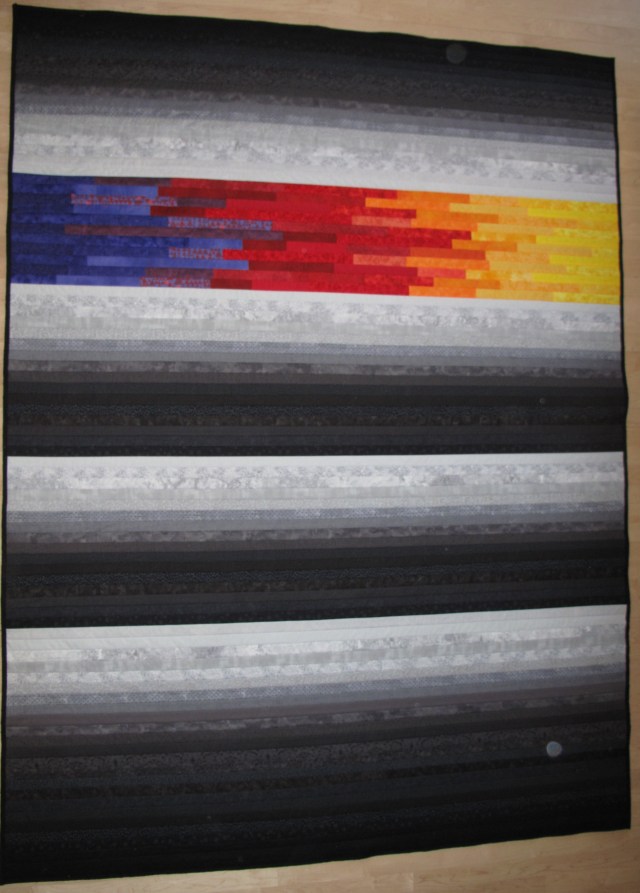
Every once in a while, the quilt design I am working on is too abstract or too intricate to be able to calculate yardage exactly. This was the case when planning the “Moonscape” quilt for my son. I did not plan out the quilt in enough detail prior to sewing to be able to calculate how much fabric I needed. Using grey fabrics and black fabrics I already had, I added other shades to create the gradation I was seeking. Not knowing how much fabric I would need, I purchased a half yard of each shade. After I had pieced his quilt, I had a lot of excess fabric.
What to do? Make a scrap quilt? Stick it back on the shelf for another day?
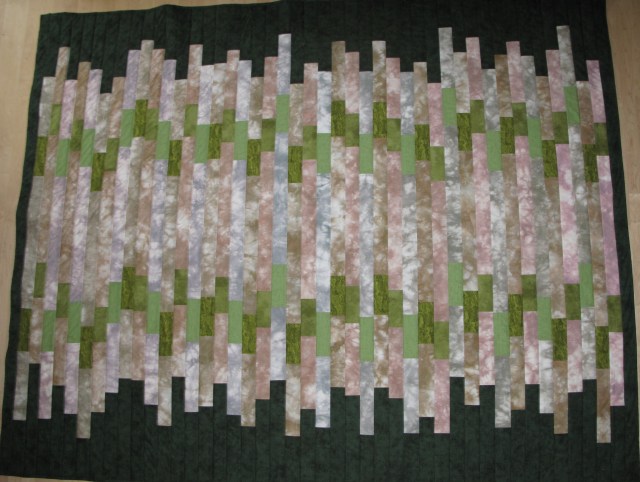
Make a strip quilt? Now, this was an idea I liked. I have been wanting to try piecing with strips on my longarm machine for a while now. So, this seemed like the best idea for a quilt to try this out on.
I loaded the backing onto the frame and pinned the batting in place. After basting the first strip in place, I cut and pieced 2″ x 72″ strips in the gradiant order of the fabric shades. To sew, I carefully measured and marked the placement of the begin and end point of the seam that I was planning to sew. Then, I used the multipoint placement, border only sewing to sew the next strip to the the first strip. The new strip sewn was flipped and ironed lightly in place before going to the next strip (my cordless iron was really helpful for this step).
A pop of color was incorporated with scraps of yellow, orange, red and purple.
I successfully used up my shades of grey and black and have another nice quilt to donate.

I enjoy reading historical fiction books. When reading, I like to look up information about the events happening at the specific time in history. This helps me understand the book’s story line better.
I enjoy these books even more when there is a reference to the art of the era. Having recently I read the latest book by Jennifer Chiaverini, I did some additional reading about the history of quilting.
One of the sources talked about Depression Era quilts. Many of these quilts were string quilts made of small fabric scraps stitched together to make a piece of fabric large enough to cut a pattern piece. These larger pieces were stitched together to make a quilt block. The quilt blocks were put together to make a quilt top. This method was used during hard times when money and fabric were scarce. Scraps of all sizes were utilized.
Over the past decade, this method has also made a resurgence within the art quilt community.

There were several pictures of a string quilts that have caught my attention.

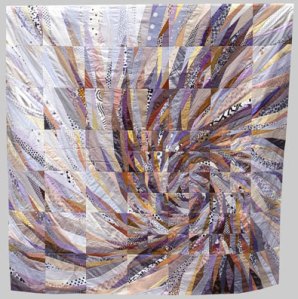
One of the quilters that I really liked was Ursula Kern. Her string quilts are breathtaking. The illusion of movement and shape that she creates is absolutely amazing.


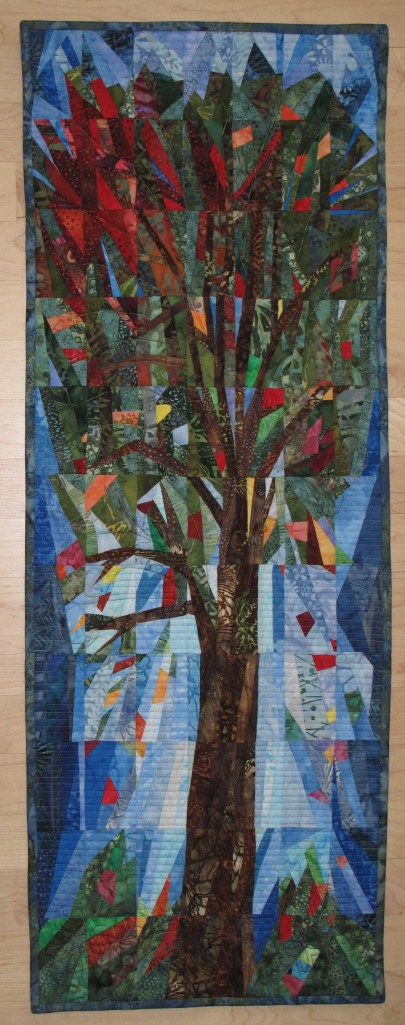
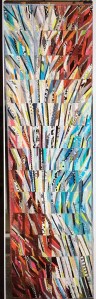
I decided that I wanted to try to make a string quilt wall hanging for my sewing room. With wall space limited, the only spot I had left to hang something was adjacent to my four seasons landscape quilt. So, in keeping the the landscape theme, I thought a tree might fit the area well.
Looking at tree clipart images, I selected one, traced it out on pellon, and then divided the pellon into a 7×11 grid. Each section of the grid (2″ x 3.75″) was used as one block of the string quilting.
Since I have a lot a scraps from various other quilts, and not wanting to purchase more fabric right now, I pulled out my scraps, sorted them by color and started creating each of the blocks.

The seventy seven blocks were sewn together (with numerous changes to match my design better). The illusion is somewhat like a stained glass window – I really like it!
For the quilting, I used one layer of Quilter’s Dream Cotton batting. To create texture for the tree and shrubs, I placed pieces of Quilter’s Dream Wool batting in these areas between the cotton batting and the pieced top. The background sky was quilted with straight lines and the tree was loosely quilted to allow the depth of the batting to show.
Having received a large quantity of fabric from my sister, I needed to make room for storing this. Sorting through my current stash of fabric, I found a container of dyed fabrics that I had made when trying different dyeing techniques.
These swatches were each 5″ x 5″. Many of my original dyeing samples were used in previous projects, such as described in “Fabric Dyeing” and “Spring has Sprung“.
The ones left were a bit dull in color. No longer needing these, I decided to make another of the many quilts in my “Future Projects” folder on my computer. To brighten them up, I combined them with white fabric and use variegated thread for the quilting. It’s amazing how the white makes even drab fabrics look cheery.
This was a simple pattern that combined these 250 different swatches in long rows separated by white sashing, turned on point and set in asymmetrically. I really like how it turned out. 
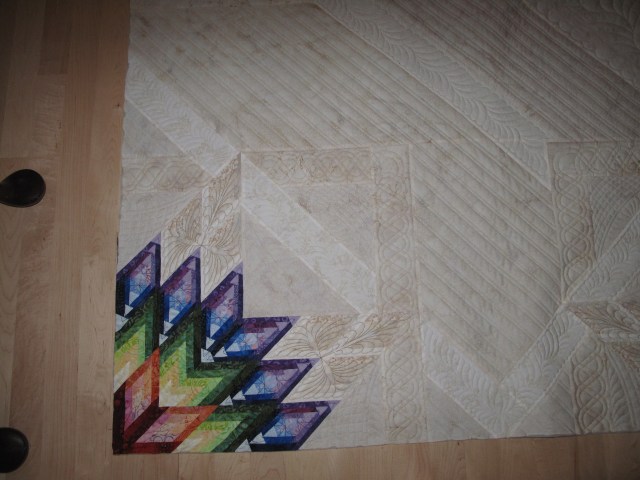
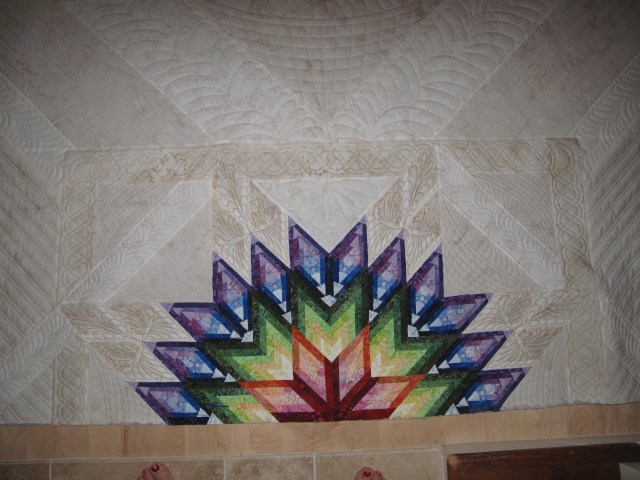
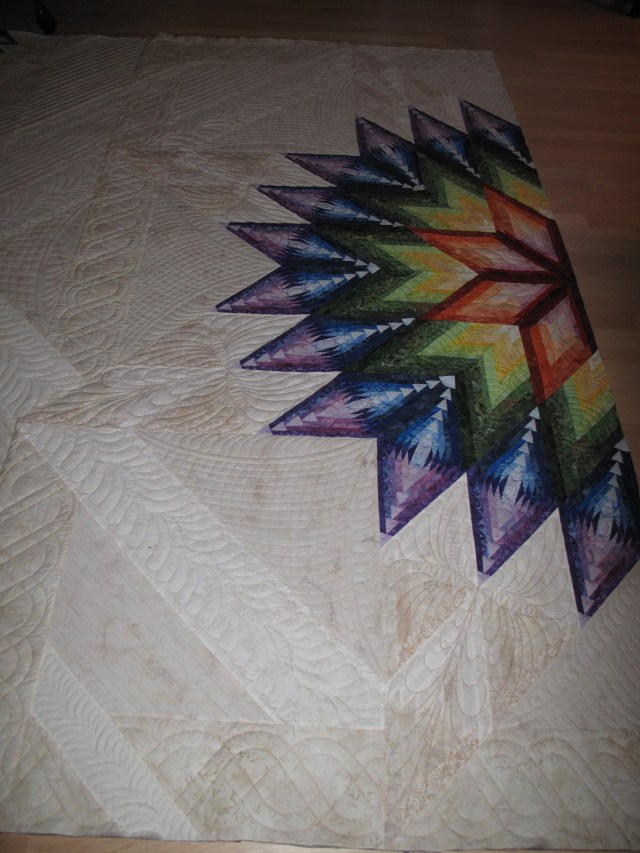
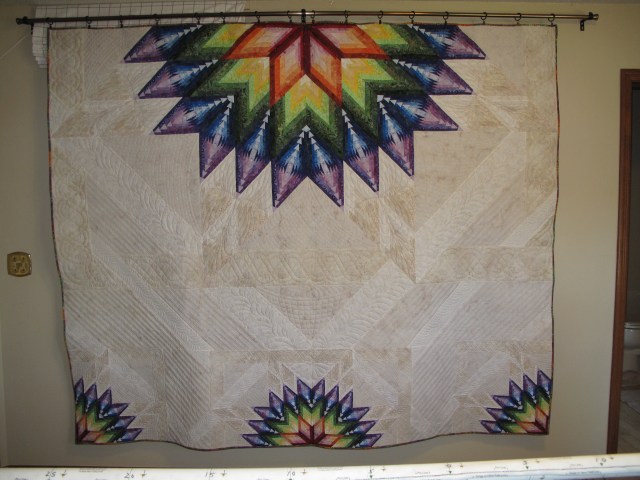
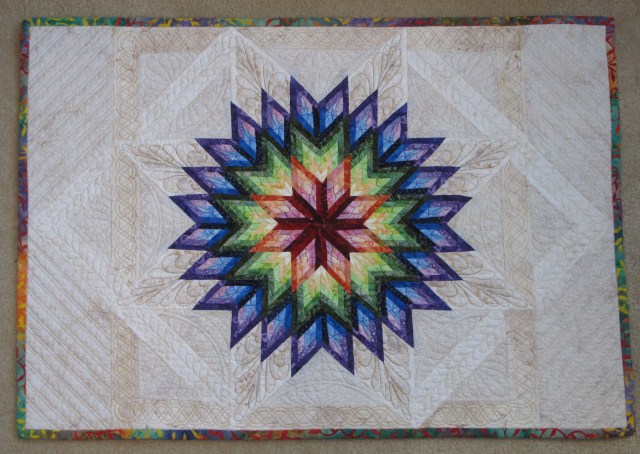
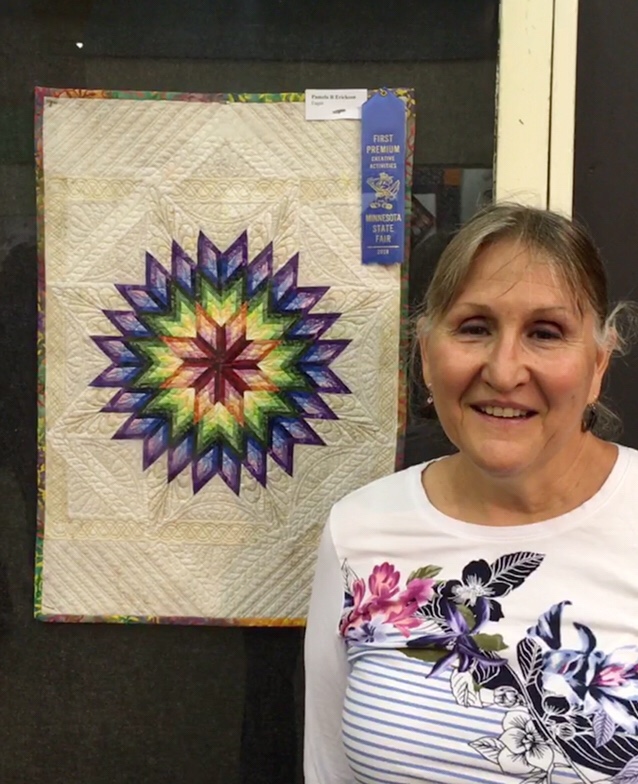
A friend recently pointed out that I had not posted pictures of the quilting of my Burst quilt, as I had originally said I would do.
So, here are a few close-ups.


And, the full quilt hanging on my wall.

I especially like how the doll quilt turned out. Kinda wish I had made the bed quilt the same design! Maybe, some day, I will make this quilt again (perhaps with a black background?)

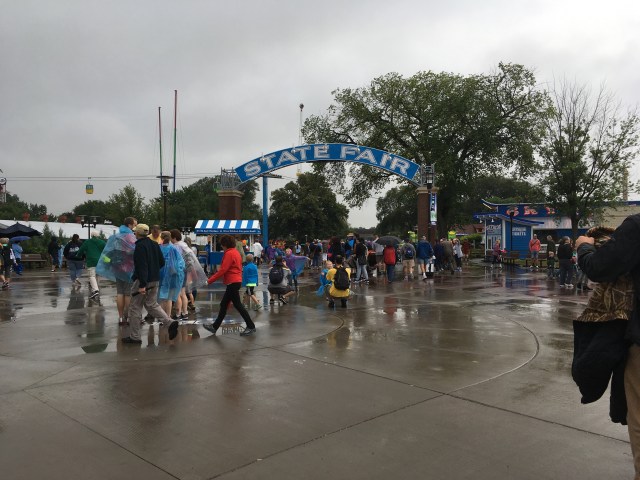
The Minnesota State Fair is currently taking place. If you are not from MN, you may not realize how big our state fair is. While MN only ranks 12th in size and 21st in population, it ranks second in state fair attendance, with over 2 million people attending each year. This is just behind Texas at 2.25 million visitors. However, Texas is second in land mass, second in population, and their state fair runs for 24 days (twice the length of the MN fair). Thus, I would say that the Minnesota State Fair outranks even Texas.
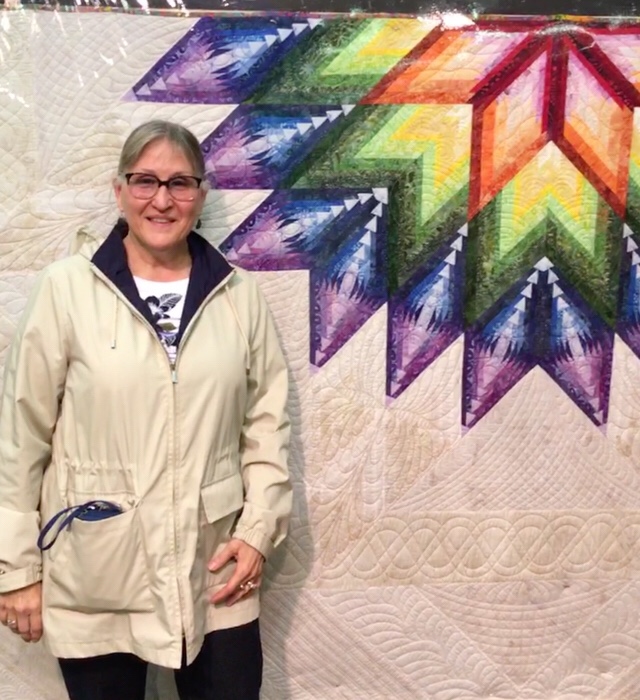
The fair is so popular that, even on a rainy morning like today, there were lots of people in attendance. What do people like to do at the fair? When I asked some of my friends, they replied: eat the food, attend a concert, eat the food, see the animals, eat the food….
I think you get the picture – there is lots of food to eat if that is what you are interested in.
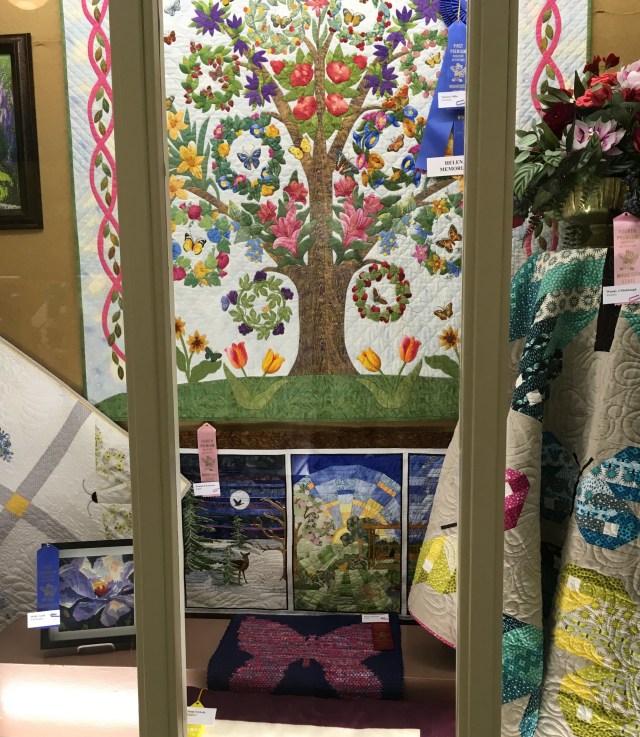
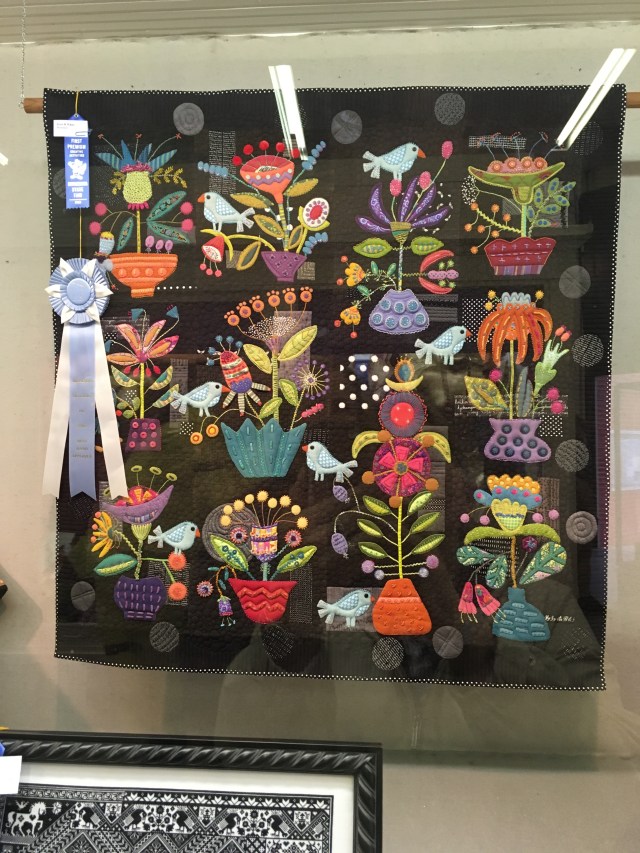
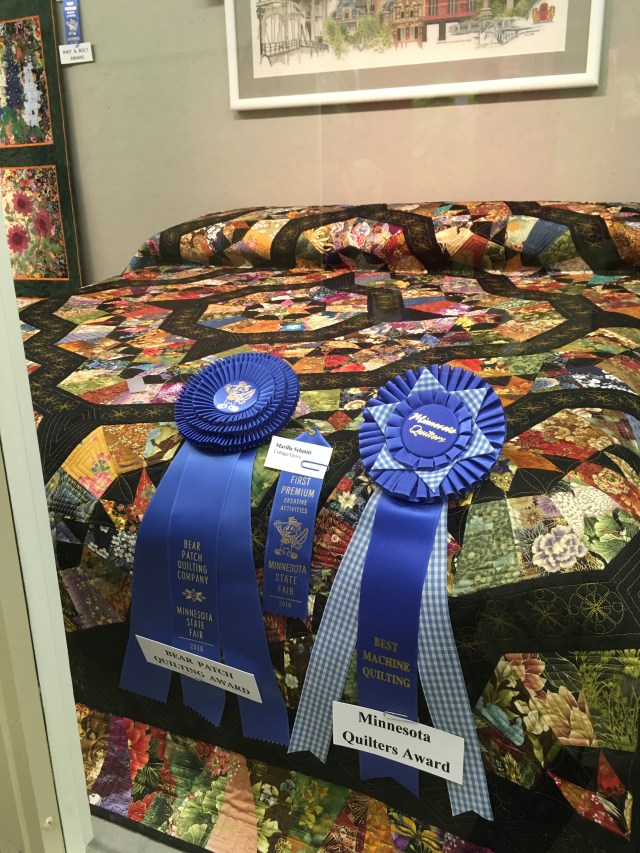
For me, the State Fair is a place to go to see the craftsmanship and creativity in the Arts and Crafts Building. Today was no exception. After getting very wet walking from the transit center to the A&C building, I spent a couple hours walking around taking pictures.
Here are my quilts:


Some of the other quilting highlights:


Some other crafts that caught my eye:
When designing a quilt, I like to plan the quilting at the same time as the piecing. This allows me to think about adding something unique to each quilt. My recent project for the two sided tree quilt was no exception.
The quilting of the tree, leaves and background would be fairly straightforward. Wanting to add something special to the quilt, I thought about what I could add to the tree. One idea was to place flowers or shrubs at the base of the tree. Another was to add some animals.
My final idea, and the one I actually used, came while reviewing some photos from my childhood. These photos brought back memories of things growing up. I decided to add theses memories to the quilt.
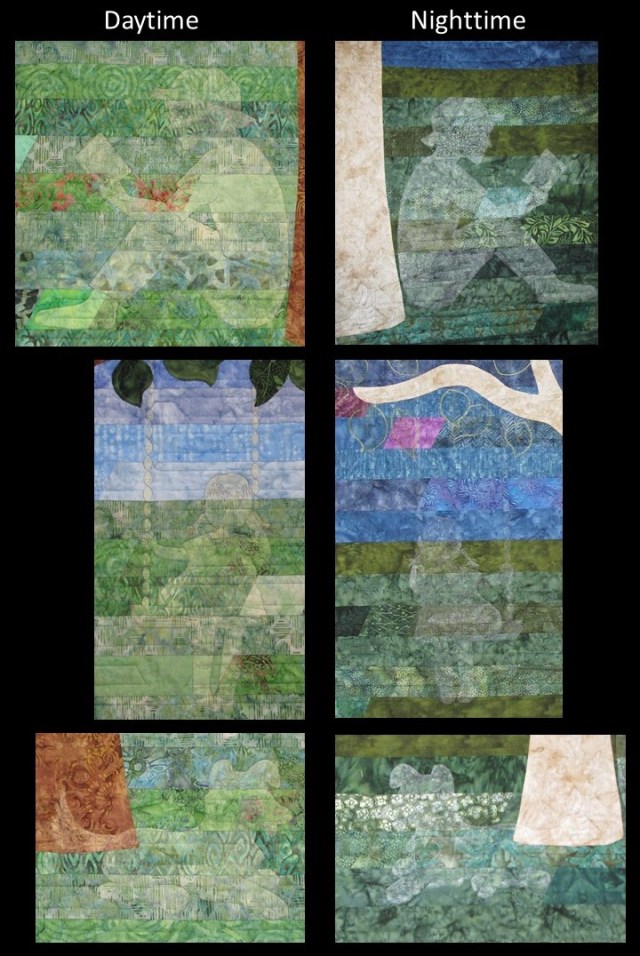
I needed to invoke the idea of a memory without overwhelming the quilt. To do that, I planned to used only thread to make the images appear very faint. After stitching, I realized that the images were there but extremely hard to see. Having recently purchase some textile medium (InFusion Textile Medium) that was very lightweight (did not stiffen the fabric) and shiny, I decided to use this to enhance the visual effect of the memories.
I am really happy how they turned out. If you look closely at the images, you will see a boy leaning against the tree reading a book, a girl on a tree swing, and their faithful dog laying on the ground near them.

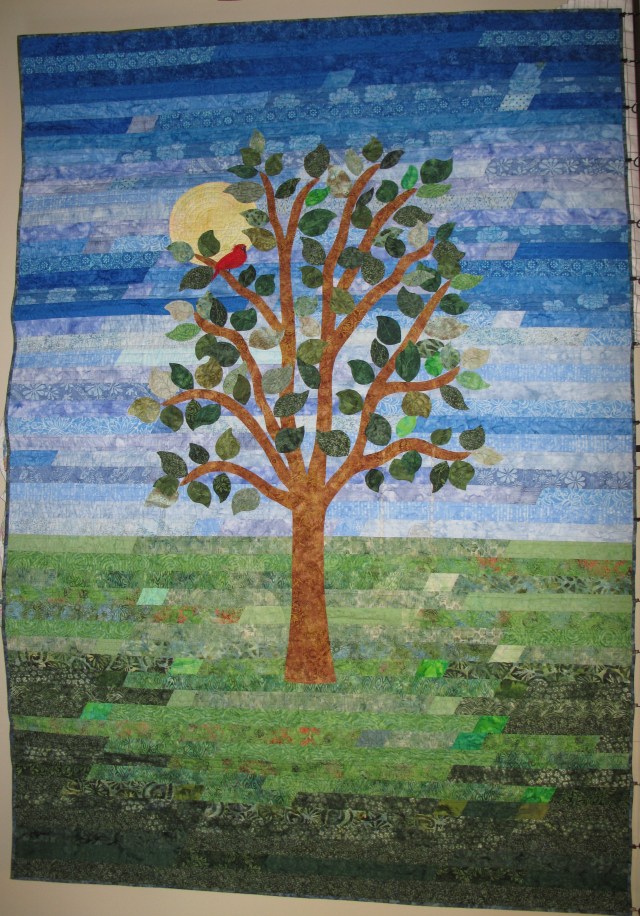
Here are the full images of the quilt front and back:


How do you applique a two sided quilt?
You think, think, plan, think some more, plan again and then finally jump in and do it. That kinda describes the process I went through when contemplating the idea of embroidering an identical tree on both sides of a quilt.
Idea #1
Idea #2
Idea #3

Daytime detail:
I decided to hand applique leaves onto the daytime side of the quilt. To do this, I pinned pieces of green fabric onto the quilted tree. Then I machine quilted the outline and veins of a leaf onto each piece of fabric. After cutting around each stitched leaf, I used needle turn embroidery to secure the edges of the fabric.
Nighttime detail:
I did not want to use the same technique on the nighttime side of the quilt. So, after completing the daytime side, I used the quilting lines as a guide to paint faint green fabric dye onto the leaves and then hand embroidered outlines around the leaves.


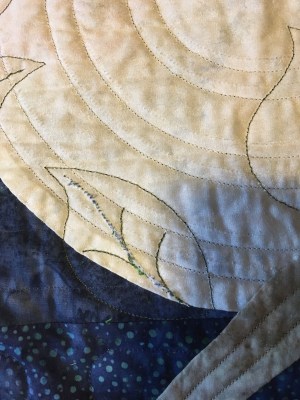
Unfortunately while quilting the leaves onto the daytime side, my long arm machine handles fell off the machine while I was working on a leaf. When this happened, the needle broke and the broken needle tore the fabric through all layers of the quilt. This picture shows that even on the backside of the quilt, the broken needle tore the fabric. I was really bummed!
To fix the tear, I could applique a leaf onto the daytime side. But, how do I fix the tear on the nighttime side. I could applique leaves on this side as well. However, that was more applique then I really wanted to do. And, I had really wanted the two sides of the quilt to use different techniques. This was really frustrating.
Ultimately, I decided to add a bit more detail to the quilt. By appliqueing an owl on the nighttime side and a cardinal to the daytime side, I was able to repair the quilt and no one can even tell that the quilt was torn.

A good repair and some nice details for the quilt! I have added more details to the quilt that were really fun to do. I will post about those soon.
You have probably seen adult coloring books in stores over the past few years. Meant as a way to unwind from daily stress, these books can take an adult back to their childhood days of coloring.
Since my crafts are my way to relax at the end of a day, I have not purchased any of these coloring books. I have however, looked at the books in stores. The pictures are complex and do provide great inspiration for quilting patterns and applique designs.
Last summer, I paged through one of these coloring books with trees. Each design featured a tree with unique patterns. Some of the designs had animals in the trees – owls, birds and even cats. One day I may make one of these, perhaps a tree with many different owls appliqued on the branches.
Directly next to the display of coloring books, was a different display featuring paper craft ideas. One idea showed strips of wrapping paper cut and glued horizontally in the background, and featured cutouts of black or white paper animals, flowers or trees as the main object. Sorry, but I did not think to take a picture of the display. But, it was a really nice idea.
This idea stuck with me, and besides thinking about making some greeting cards with the idea, I realized that a quilt could be made with a similar design. At the time I first saw the display, my paper craft supplies were buried in the back of my craft storage closet, so the cards would need to wait. But, I did have lots of fabric that I could utilize for a quilt.
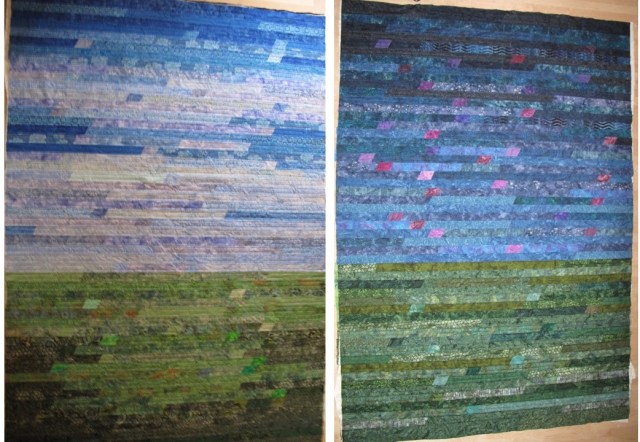
So, I set out to work on my new design. Many of my batik scraps were blue and green, which would work well for the background of a tree.
Sorting through the fabrics, I couldn’t decide whether I wanted a the colors to depict a tree during the daytime, the nighttime, or an unsorted scrappy look. After playing around with a graphic program, I ruled out the scrappy look because it was too chaotic for my liking. But, I simply just couldn’t decide which of the other two I preferred. So, I thought I would try something new and make a two sided quilt – one side with bright daytime colors, the other side with darker nighttime colors. After cutting 2 1/2″ strips, the fabrics were sewn together with some shorter pieces inserted periodically to add some variation to the background.
Since I had decided to try to make the applique exactly reversible, the quilting the front and back together would need to be done next. When loading the pieced backgrounds onto my long arm machine, I realized that making a completely reversible quilt was going to be rather difficult.
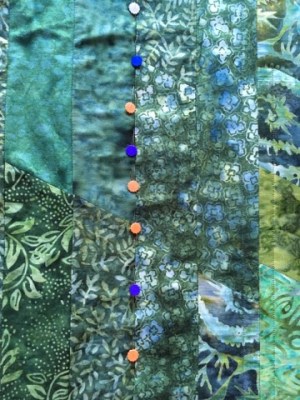
This year, in particular, my ideas for quilts have been easy in the planning stages, but more challenging when actually sewing. This quilt was no exception. On paper, it looked straightforward – sew the strips, load it on my quilting frame and quilt away. Right! Actually, wrong. Lining up so many seams on the front and the back of the quilt prior to machine quilting was definitely not easy. I discovered that even though my piecing was exact, the number and location of the seams impacted the stretch and movement of the two pieces of fabric. I ended up having to pin along each seam of the layers to try to get my quilting to look right on both the front and the back of the quilt. 

Once the backgrounds was quilted, I decided to get my least favorite part of any quilt (the binding) done before I would start work on the appliqued tree. More on that in my next posting.
Since moving into my newer sewing room, my paper craft supplies are now accessible, so cards can once again be made. That project will be included in a future post as well.
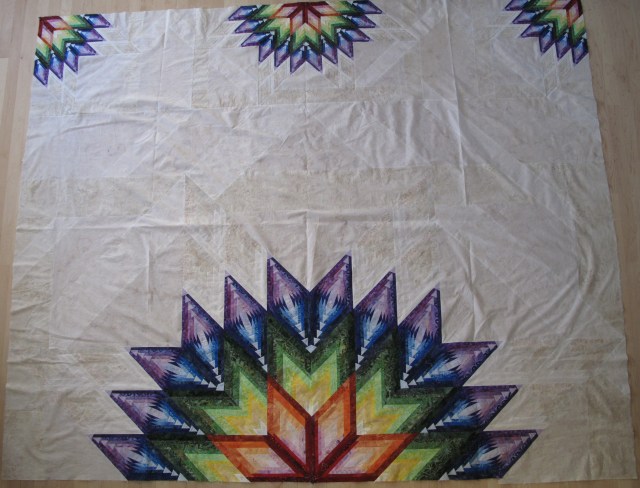
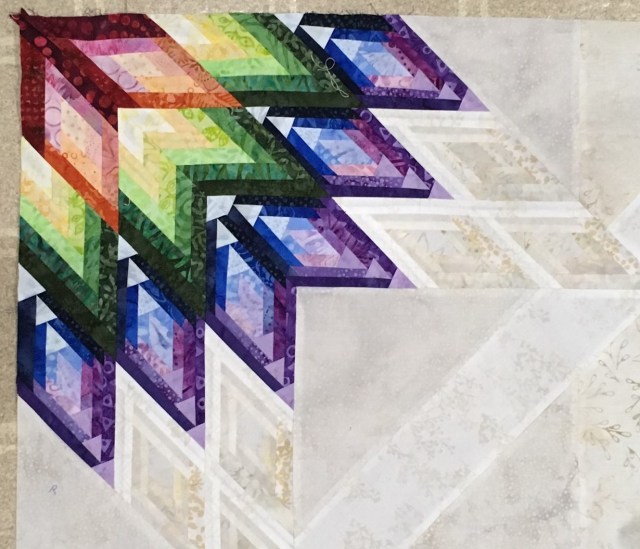
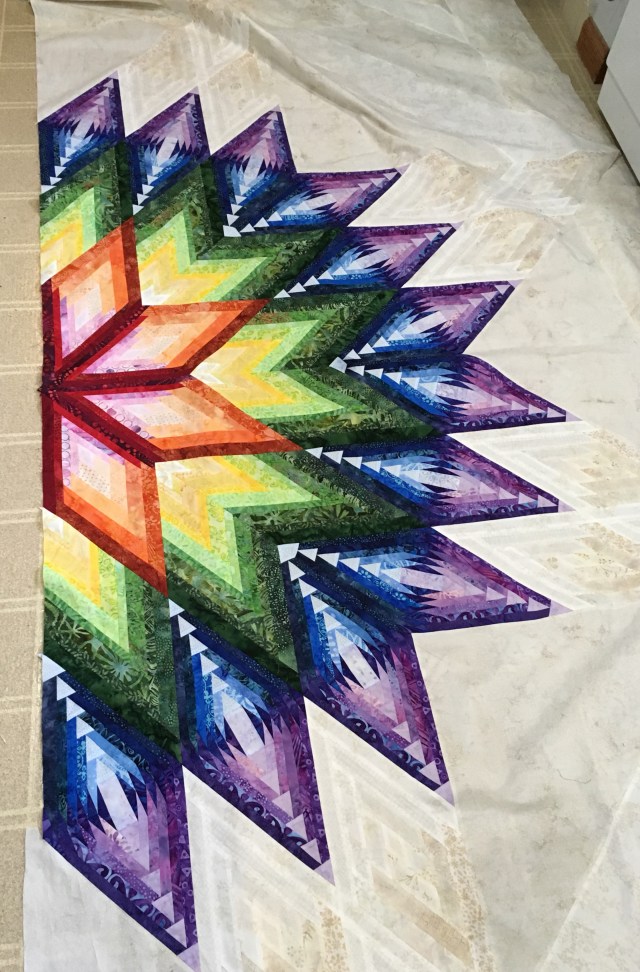
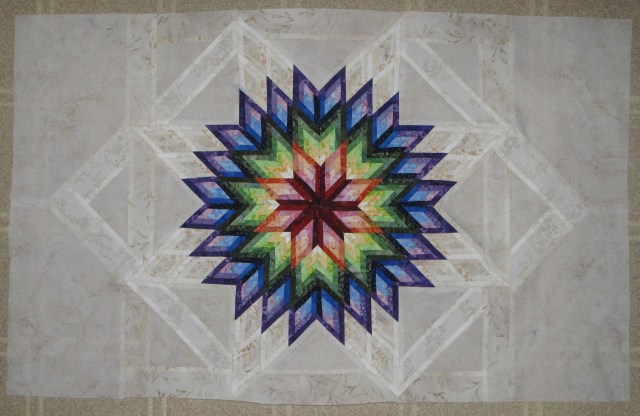
After several more hours of sewing, the piecing if finally done.


But the result is awesome!
Some statistics:
Number of blocks sewn:
Red/Orange Blocks = 8 small, 4 large
Yellow/Green Blocks = 16 small, 8 large
Blue/Purple Blocks = 24 small, 12 large
Cream Blocks = 24 small, 12 large
Total = 72 small, 36 large
Number of Piece in Large Starburst:
Red = 36
Orange = 32
Yellow = 56
Green = 80
Blue = 144
Purple = 156
Cream = 156
Number of Piece in Small Starburst:
Red = 40
Orange = 32
Yellow = 48
Green = 96
Blue = 192
Purple = 168
Cream = 212
Total Pieces (not including background) = 1453!
I also pieced together a Doll Quilt – this one has 680 pieces in a 18″ x 24″ miniature quilt.

The background quilting design for each of these will have a different for each cream section in the design. The quilting will take me many hours to complete. With everything else I am doing, it may be a few month before I post the finish pictures.